 Marrakech Guidebook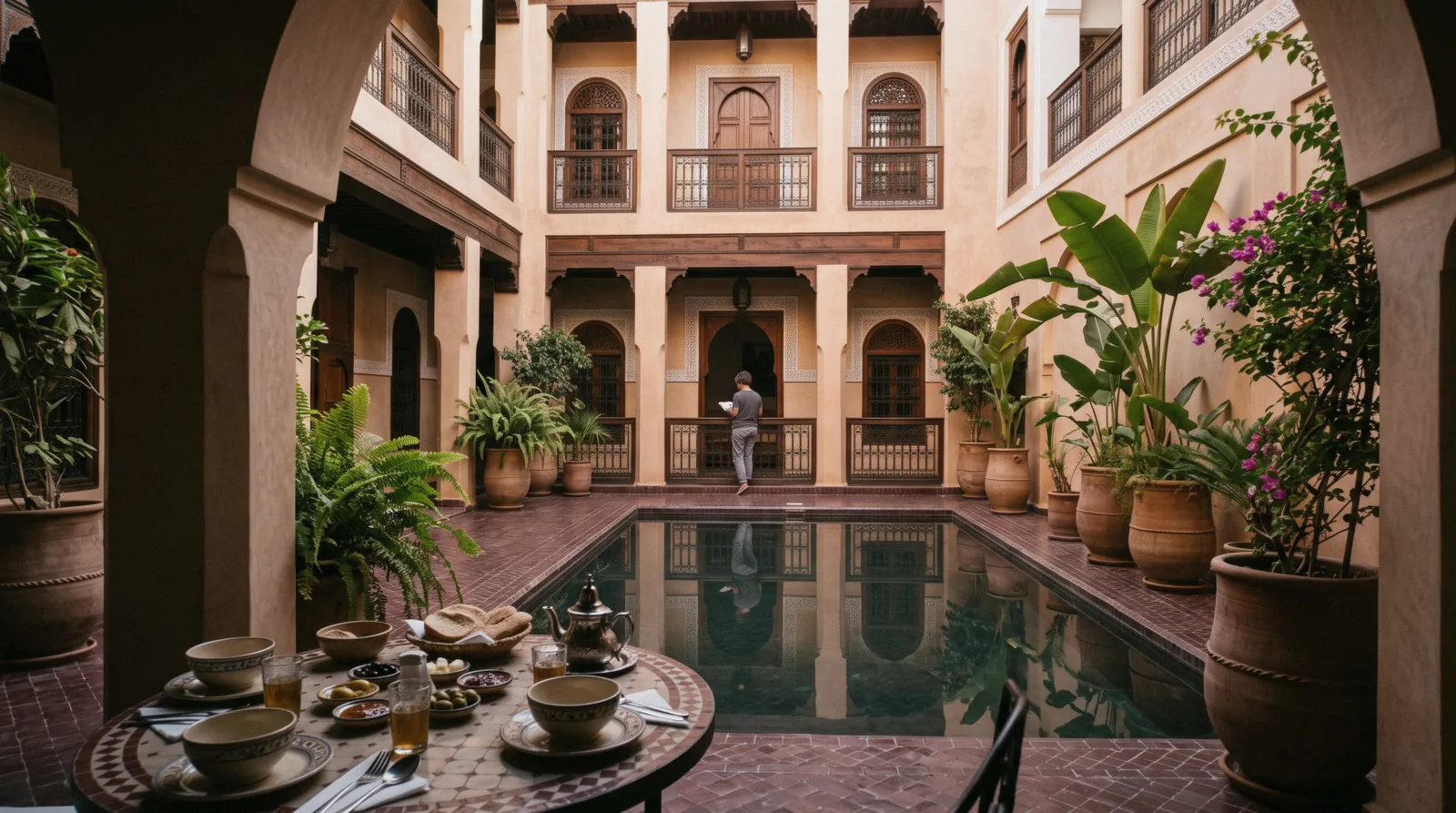
Where to Stay in Marrakech
Where to stay in Marrakech is a question about access before it is a question about taste. One choice puts you inside a walled quarter where no car reaches your door and a porter carries your case down a lane; the other puts you in a protectorate-era grid with street numbers, pavements and a taxi that can find you. This page compares six areas on that basis, sets out what Moroccan law now says a riad actually is, prints the statutory tourist-tax brackets and the reason the city's own rate is not published, and names the sixteen Marrakech hotels the MICHELIN Guide has given Keys. Prices are in US dollars first with the dirham figure in brackets, because the dirham number is the official one. the Marrakech city guide is where the tickets, the districts and the itineraries meet.
Quick answer Which area, what a riad legally is, what the bill adds
Moroccan accommodation law was rewritten under Loi 80-14, and since the classification order took effect the riad and the kasbah are classified types in their own right, rated luxe to three stars, with maisons d'hotes moved onto a one-to-five star scale. Operators were given twenty four months to comply, so most Marrakech riads advertising a star rating in 2026 have not been reassessed under the new grid at all.
Key takeaways
- The real decision is the walled city or the grid: a riad inside the medina is reached on foot with a porter, while Gueliz has street numbers, pavements and a taxi that can pull up outside
- The bill carries two separate levies, the taxe de sejour and the taxe de promotion touristique. The statutory band for a riad or guest house is $1.60 to $3.20 (15 to 30 MAD) per person per night, children under twelve are exempt, and the city's own rate is not published anywhere we could reach
- The one third-party list worth citing is the MICHELIN Guide hotel selection: 49 Marrakech properties, 16 of them carrying Keys. There is no MICHELIN restaurant selection anywhere in Morocco, so a hotel restaurant here holds no such distinction
- Book the first night around your arrival, not your budget. A private airport transfer is listed at $8.29 and drops you at the nearest vehicle point; a metered petit taxi has no published tariff to argue against
Six Marrakech Areas Compared
Distances are straight lines computed from the published coordinates of each quarter to Place Jemaa el-Fna, so the walked line is longer, and inside the medina it is longer again because the lanes do not run straight. The coordinates come from Wikidata items verified in Q3 2026; the Mellah has no published coordinate at all, so its figure is measured from the Bahia Palace beside it.
| Area | Straight line to Jemaa el-Fna | Suits | The trade you make | Guide |
|---|---|---|---|---|
| The medina, inside the walls | Under 1 km from most riads | A first visit, monuments on foot, riad courtyards | No vehicle reaches most doors, and lanes are numbered by derb rather than by street | The medina |
| The Kasbah, southern medina | 1.1 km | Early starts at the ticketed monuments, quieter nights inside the walls | Dinner and shops thin out south of the palaces after dark | The Kasbah |
| The Mellah, south-east medina | 0.9 km, measured from the Bahia Palace | Cheaper riad rates a few minutes from three ticketed monuments | No official source publishes anything about the quarter, its synagogue or its cemetery | The Mellah |
| Gueliz, the ville nouvelle | 2.0 km | Street addresses, hotels with lifts, the railway station, longer stays | Fifteen minutes and a fare away from everything inside the walls | Gueliz |
| Hivernage | 1.6 km | Big hotels with pools and parking, a short walk to the Koutoubia | The quietest and least characterful of the six at street level | Hivernage |
| The Palmeraie | 7.2 km | Pools, gardens, families with a car or a driver | Every trip into the city is a taxi both ways, and no bus line list has been published since the operator changed | The Palmeraie |
UNESCO defines only the medina and the Kasbah within it. Gueliz and Hivernage are described by the national tourist office but have no published boundary, and for the Mellah, the Palmeraie district and Sidi Ghanem no official definition was reachable at all, so those descriptions are ours.
Arrivals, Guides and the First Evening
The bookings that actually depend on where you sleep: the transfer that gets you to a door no car can reach, the private guide who walks you out of the medina on the first morning, and the hammam most riads will otherwise book for you at their own price. Prices and ratings as listed by the operator on GetYourGuide.
 from $8.29
Marrakech: Private Transfer to/from RAK Menara Airport
listed at $8.29
Private transfer between Menara airport and your Marrakech address, about 20 minutes. Vehicles cannot enter parts of the medina, so the drop-off can leave a 5-10 minute walk with luggage.
Check Availability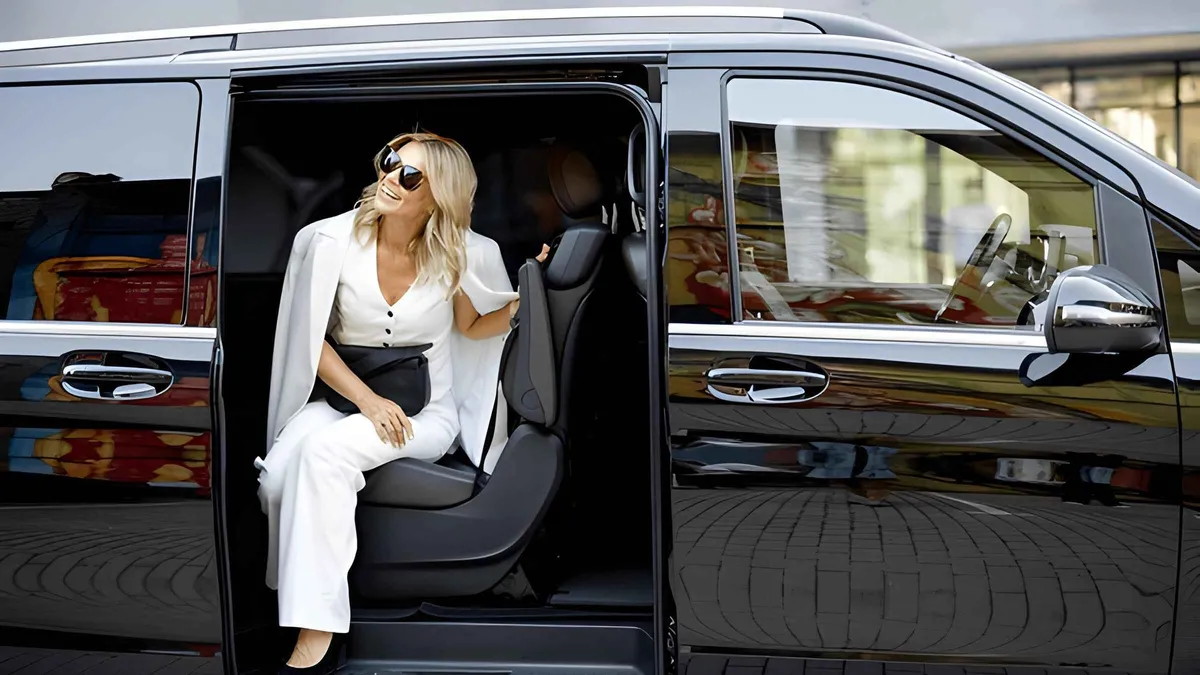 from $7.19
Marrakesh: Private One-Way Transfer to or from RAK Airport
listed at $7.19
One-way private transfer to or from Menara airport, about 30 minutes, in English, Arabic, French or Spanish. Medina riads are served at the nearest point a car can reach.
Check Availability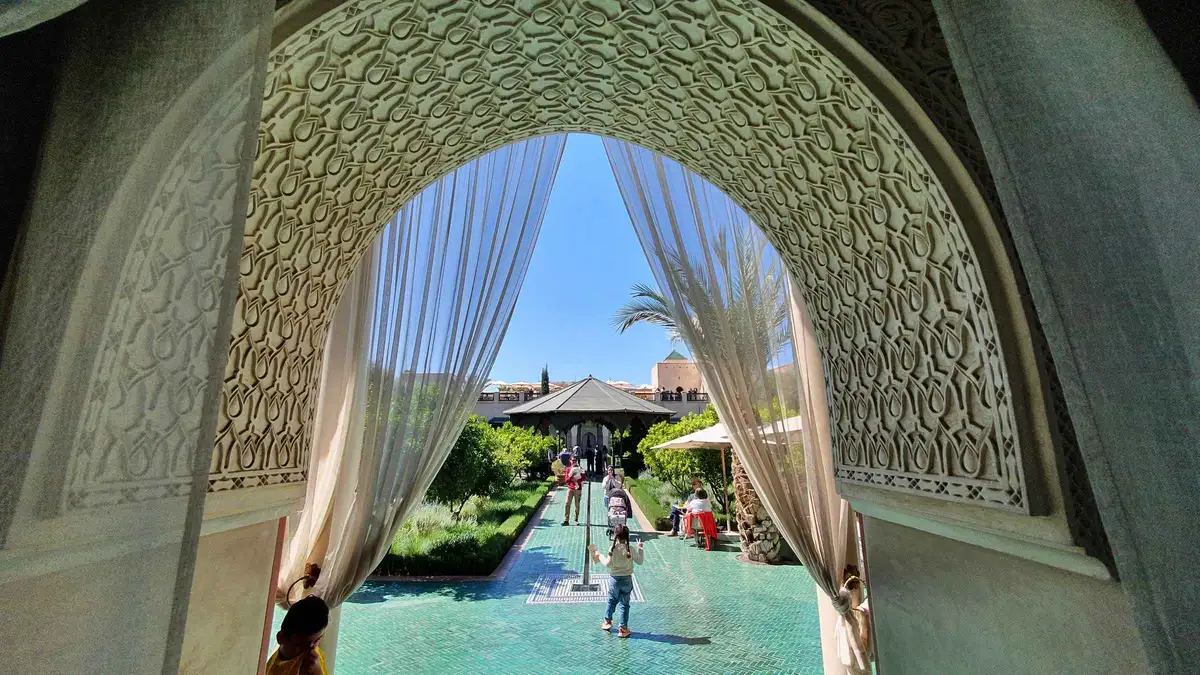 from $66.35
Marrakech: Tailor-Made City Tour With Your Own Private Guide
listed at $66.35
Half or full-day private tour built around what you ask to see, with pickup included. Up to two sights on the half-day and four on the full day; entrance fees are not included.
Check Availability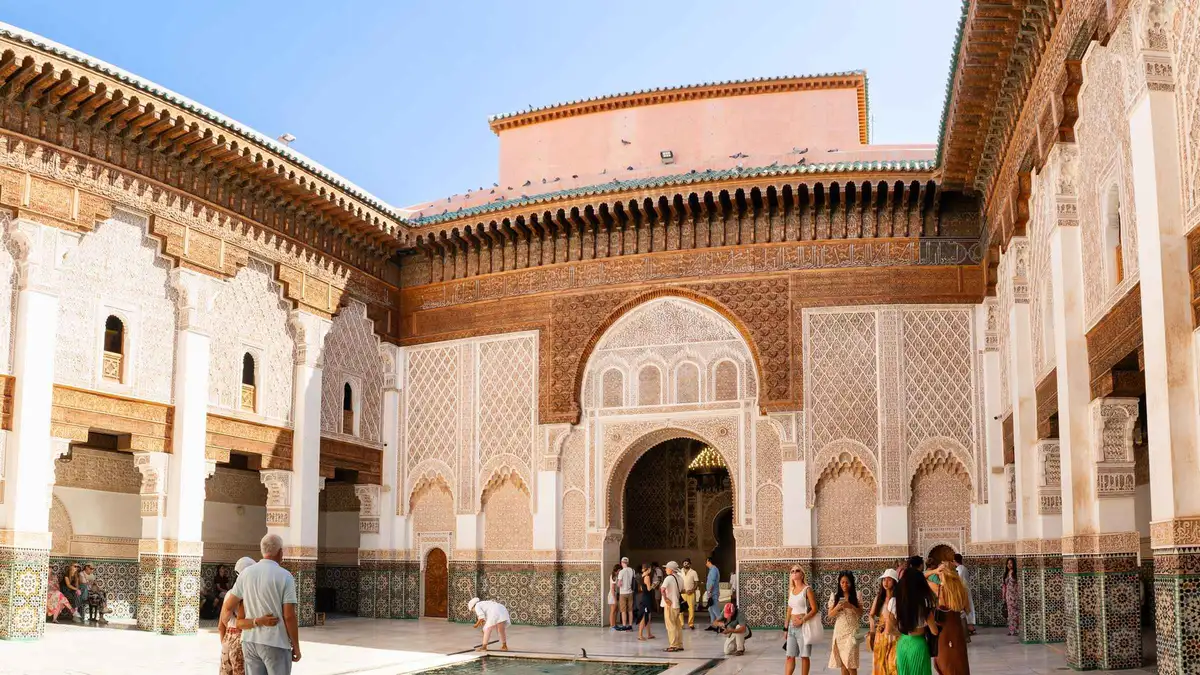 from $17.47
Marrakech: Historical Monuments, Souks & Medina Guided Tour
listed at $17.47
Four-hour licensed-guide circuit of the medina monuments, souks and lanes, with a WhatsApp briefing the day before. Private option includes riad pickup; monument tickets are separate.
Check Availability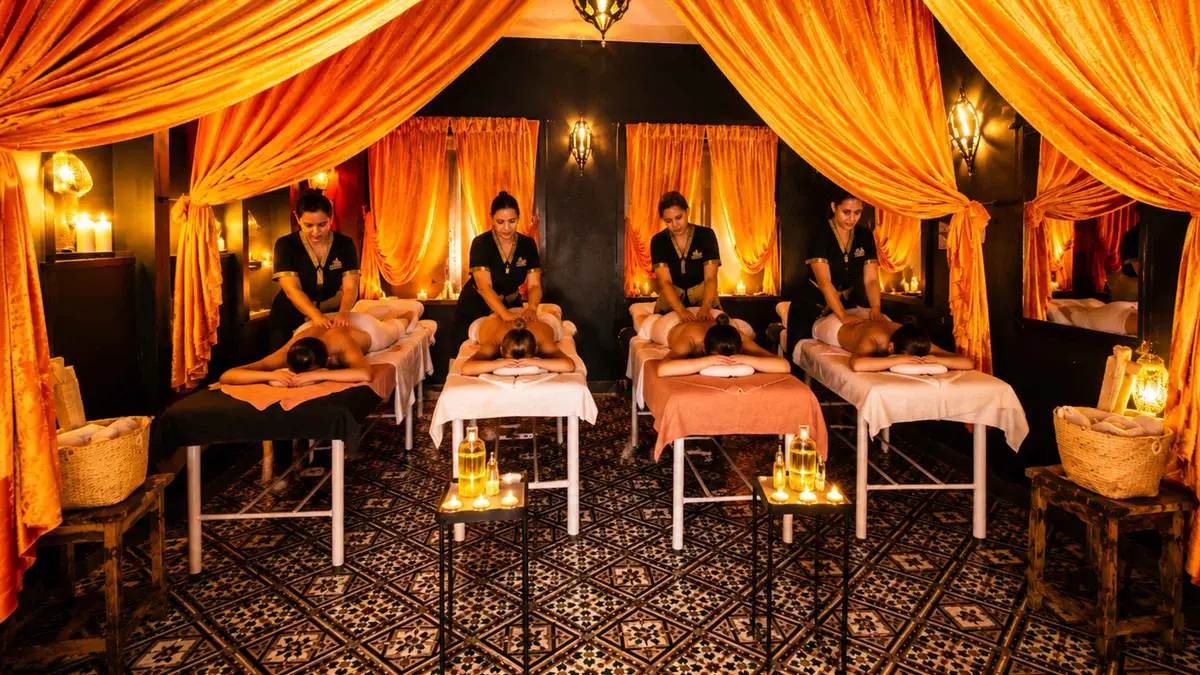 from $44.78
Marrakech: 2-Hour Traditional Moroccan Hammam Experience
listed at $44.78
Two-hour traditional hammam with black soap, kessa scrub and a massage at a city spa. No transfer included, so you make your own way there.
Check Availability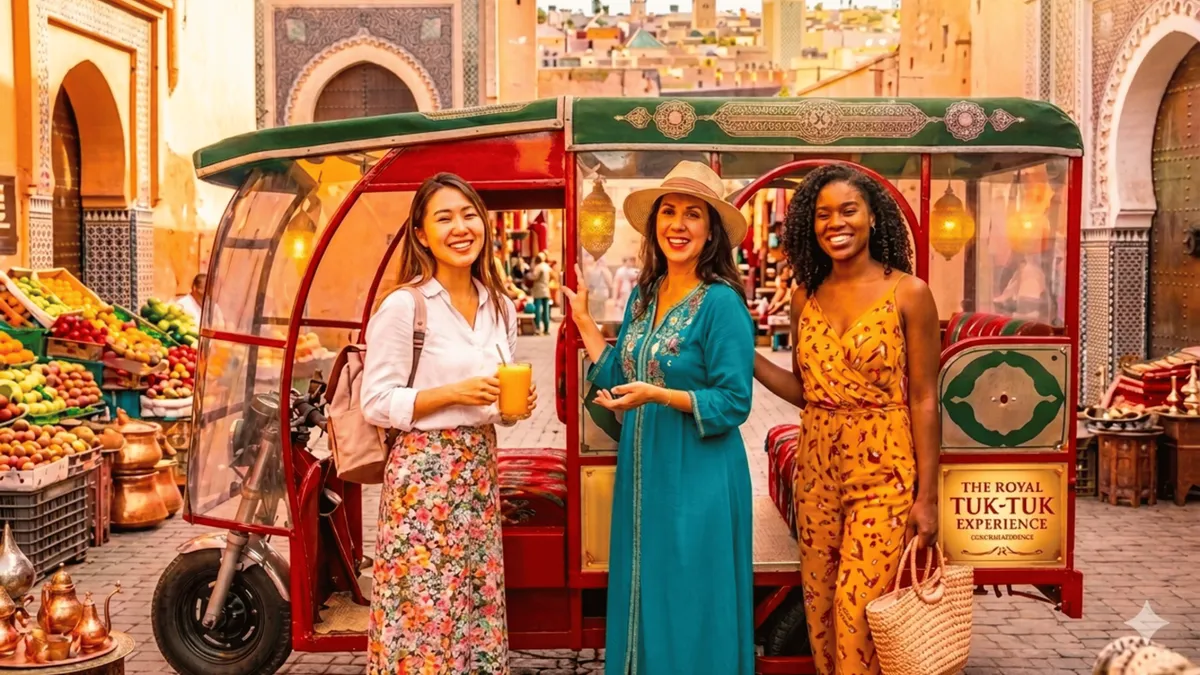 from $16
Tuk Tuk Marrakech Private Tour: Audio guide, Gift & Pastries
listed at $16
One to three-hour private tuk-tuk circuit with an audio guide, pastries and a gift; a driver, not a guide, is provided. Monument tickets are not included and Majorelle tickets have to be bought online first.
Check AvailabilityPrices, ratings and details are the platform's own, checked in Q3 2026; dollar figures are the listed prices — the platform bills in your account's currency.
What a Riad Is in Moroccan Law, and Why the Stars Do Not Mean What They Say
This is the single most useful fact on the page and no English-language guide states it. The law that governs Moroccan accommodation was rewritten, the classification order took effect, and the transition period is still running while you book.
Loi 80-14 on tourist establishments, promulgated by dahir 1-15-108, replaced the old regime of loi 61-00. Its classification standards were fixed by joint order 985-24 of the Minister of the Interior and the Minister of Tourism, published in the Bulletin Officiel 7407 bis. What that order did matters to anyone booking a courtyard house: it created ten official accommodation types, and the RIAD and the KASBAH are two of them, classified in their own right rather than lumped in with guest houses.
The other eight are hotel, hotel club, tourist residence, RIPT, maison d'hotes, camping, gite and pension.
The ladders, type by type
Each type carries its own ladder, and they are not the same length. A riad or a kasbah runs luxe, five, four or three stars, and stops there: there is no two-star or one-star riad in law. A maison d'hotes runs five down to one star and has no luxe rung at all, which is a real change, because until the order took effect guest houses were graded in categories rather than stars.
That is the source of most of the confusion you will meet on booking sites.
| Type | Classification ladder | What the word means in the order |
|---|---|---|
| Riad | Luxe, 5, 4 or 3 stars | A house of traditional Moroccan architecture providing accommodation and complementary services |
| Kasbah | Luxe, 5, 4 or 3 stars | A fortified residence of historic architecture |
| Maison d'hotes | 5, 4, 3, 2 or 1 star, no luxe rung | A villa or house offering furnished rooms with accommodation services |
| Hotel | Luxe, 5, 4, 3, 2 or 1 star | The familiar ladder, unchanged by the reform |
| Hotel club | Luxe, 5, 4 or 3 stars | Resort format with an in-house activity programme |
| Tourist residence | Luxe, 5, 4, 3, 2 or 1 star | Serviced apartments rented by the night |
How a property earns its rating
The order splits the criteria into mandatory norms, marked A, and complementary norms, marked B. In the annexe's own words an establishment must meet 100 per cent of the mandatory norms and at least 70 per cent of the total points of the complementary norms. Assessment is by mystery visit against grids running to several hundred criteria, developed with UN Tourism; a newly built establishment is reassessed every seven years and an existing one every five.
The twenty four month gap you are booking inside
Operators were given twenty four months from publication to comply. The practical consequence is blunt: a Marrakech riad advertising four stars in 2026 is in most cases carrying a claim made under the old scheme, not a rating awarded under the new grid, and no public register exists to check it against. We looked for one on the tourism ministry's site and on the national tourist office's site and found the legal texts and the blank administrative forms but no list of classified establishments.
Treat a star on a riad's own website as marketing until the property shows you the classification decision.
The gap the state itself describes
The Economic, Social and Environmental Council recorded the enforcement problem in its opinion on the bill, noting that the previous perimeter did not cover riads and kasbahs at all, and that some operators run in its words uniquely on the basis of the operating authorisation, without pursuing the procedure through to obtaining an operating classification, which leads to the proliferation of unclassified establishments. That is the official body's own description of the market you are booking in, not a traveller's grumble.
One thing the grid does not contain
We searched the full annexe of the classification order for accessibility language, all 147,099 extracted lines of it, and found no occurrence of reduced mobility, PMR, handicap or accessibility. The only handrail references are stair rails. Press coverage claimed the mandatory norms cover access for people with reduced mobility; the text we read does not.
If a step-free route matters, ask the property for photographs of the entrance lane, the door sill and the stairs, because a riad is built around a courtyard with rooms on two or three floors and often no lift.
The Real Choice: The Walled City or the Grid
Every other decision on this page follows from this one, and it is a decision about how you and your luggage arrive.
Inside the medina the address is a derb, a lane, and the lane is usually too narrow for a car. In practice the riad sends someone to meet you at the nearest point a vehicle can stop and your case is carried or barrowed the rest of the way. No authority publishes a vehicle-access rule for medina streets, so we describe that as what happens rather than as a regulation, and it is the reason arrival time is worth more thought than area: finding an unlit derb at midnight with a suitcase is the one part of a Marrakech trip that reliably goes wrong.
Gueliz is the mirror image. It was laid out as the ville nouvelle west of the walls, it has numbered buildings on named avenues, and a taxi driver can take you to the door. It is also where the railway station stands, on Avenue Hassan II, and where bus 19 from the airport ends its run.
The cost is distance: the straight line from the Gueliz centre to Jemaa el-Fna is 2.0 km, and every evening in the medina finishes with a fare.
Hivernage sits between the two, a quarter of large hotels, gardens and wide avenues immediately outside the walls, and the national tourist office groups it with Gueliz in its own words as offering the most modern infrastructures, luxury boutiques and international ready-to-wear stores, airy avenues. The Kasbah and the Mellah are both inside the walls but in the quiet south, close to the ticketed monuments and further from the square. The Palmeraie is a different proposition again: a palm grove listed by UNESCO among the property's natural components, 7.2 km out, where you are buying a pool and a garden and accepting a taxi in both directions.
What the Bill Adds, and the Rate Nobody Publishes
Two levies land on a Marrakech room bill, both charged per person per night on top of the room rate, and the city's actual figures could not be obtained from any official source.
The legal basis is loi 47-06 on the taxation of local authorities, chapter IX. Article 70 makes the taxe de sejour payable at tourist accommodation on top of the room price; article 72 makes it due per person per night by establishment category; article 73 sets the statutory brackets and leaves the commune to fix the exact rate inside them. Separately, a taxe de promotion touristique is levied on the same bill.
Any single city-tax figure you are quoted online almost certainly merges the two without saying so, which is why our table gives the statutory bracket for one levy and stops there.
The statutory brackets, by category
These are the article 73 bands as enacted, converted at the site rate. Loi 07-20 amended the taxe de sejour tariffs and the amended table could not be reached, so treat the bands as the last text we could read rather than as certainly current. Article 71 exempts unclassified hotels, pensions, camping and caravan sites, youth hostels and children under twelve, and sets no maximum number of nights.
| Accommodation type | Per person, per night | Two adults, three nights | Who this covers |
|---|---|---|---|
| Guest houses, palaces and luxury hotels | $1.60 to $3.20 (15 to 30 MAD) | $9.59 to $19.17 (90 to 180 MAD) | The band a classified riad or maison d'hotes falls in |
| Five-star hotels | $1.07 to $2.66 (10 to 25 MAD) | $6.39 to $15.98 (60 to 150 MAD) | The Hivernage and Palmeraie resorts |
| Four-star hotels | $0.53 to $1.07 (5 to 10 MAD) | $3.20 to $6.39 (30 to 60 MAD) | Most Gueliz business hotels |
| Three-star hotels and tourist residences | $0.32 to $0.75 (3 to 7 MAD) | $1.92 to $4.47 (18 to 42 MAD) | Serviced apartments and mid-range hotels |
| One and two-star hotels, motels, gites | $0.21 to $0.53 (2 to 5 MAD) | $1.28 to $3.20 (12 to 30 MAD) | The cheapest classified tier |
Why we print no Marrakech figure
The commune advertises its consolidated local tax decision on its own website and the download link returns a 404. Its quarterly declaration form for accommodation providers leaves the box marked Taux de la taxe blank and prints no rate table. The commune's tax category index answers but is empty, and marrakech.ma does not resolve at all.
The 15 plus 11 dirham figure that circulates on property-management blogs has no authority behind it, so it is not on this page. Ask the property what it charges per person per night, and ask whether the figure includes the promotion levy: the invoice is the only document in this chain anyone can actually produce.
The MICHELIN Keys, and the Selection That Does Not Exist
One correction first, because it is repeated everywhere: there is no MICHELIN Guide restaurant selection in Morocco. Searching Marrakech on the Guide's own restaurants page returns the message that there are no selected restaurants in the area searched, and Casablanca returns the same. No stars, no Bib Gourmands, nowhere in the country.
What does exist, and is worth using, is the hotels selection. The Guide lists 49 Marrakech properties, of which 16 carry Keys, its accommodation distinction. Because a hotel write-up sometimes praises the in-house restaurant, we say it plainly: that is not a restaurant distinction and nobody should book a table on the strength of it.
The sixteen with Keys
Read from the Guide's own Marrakech hotels pages in Q3 2026. Notice how many of them are riads rather than resorts, which is the clearest evidence that the courtyard house is the format the city is actually judged on.
- La Mamounia, three Keys, the only Moroccan property at that level
- Royal Mansour Marrakech, two Keys
- Amanjena, two Keys, out of town on the Ouarzazate road
- The Oberoi Marrakech, two Keys
- Selman Marrakech, one Key
- La Sultana Marrakech, one Key, inside the Kasbah
- Ksar Char-Bagh, one Key, in the Palmeraie
- IZZA Marrakech, one Key
- Maison Brummell Majorelle, one Key, in Gueliz
- Palais Ronsard, one Key
- Riad Dar Al Dall, one Key
- Riad Tarabel, one Key
- Riad Due, one Key
- Riad No. 37, one Key
- Riad Sakkan, one Key
- Villa des Orangers, one Key, Relais et Chateaux
The other 33 properties in the selection, among them the Mandarin Oriental, Nobu, Park Hyatt, Jnane Tamsna, Les Jardins de la Medina and a long list of riads, appear in the Guide without a Keys string we could confirm. We describe those as listed in the MICHELIN Guide hotel selection, Keys not confirmed, because the fetch went through a text proxy and a rendering failure cannot be ruled out. A first edition of Gault et Millau Morocco was reported this year with 135 addresses, but we could not read the guide's own site, so nothing on this page rests on it.
Booking Around Your Arrival, Not Your Budget
Where you sleep decides how you get there, and the transport facts split cleanly by district.
Bus 19 runs from the airport to Gueliz in thirty minutes, and the commune's own timetable lists every departure at a quarter past and a quarter to the hour, first at 06:15, last at 21:15, identical every day of the week. The fare quoted by the official destination guide is $3.20 (30 MAD) one way, with $5.33 (50 MAD) return published by an airport information site rather than by the airport operator. The route runs along Avenue Mohammed VI through Hivernage and past the Koutoubia before it reaches Gueliz, so it serves four of the six areas on this page and misses the Kasbah, the Mellah and the Palmeraie entirely.
Details are on the airport transfer page.
A taxi is where the numbers stop agreeing. A Marrakech prefectural decision replaced the flat airport price with seven distance zones, starting at 100 MAD under 3 km and rising to 160 MAD in the 13 to 15 km band, with a night rate quoted at 120 MAD from 21:00 in summer and 20:00 in winter. The official destination guide still prints 70 MAD by day and 100 MAD by night.
The airport operator publishes no figure at all, only that fares are posted at the taxi parking area, and it has opened a prepaid single-window desk where you state a destination and pay in advance. Inside the city, no authority publishes the petit-taxi meter figures either: what is published is that the meter is compulsory, under a dahir of 1963 restated by ministry circulars. The meter is the protection, not a price list. Getting around sets out both.
Two consequences for the booking. First, if you land after dark and you have booked inside the walls, arrange the pick-up with the riad rather than improvising, because the last hundred metres are the part no vehicle covers. A private transfer is listed at $8.29 and a one-way private transfer at $7.19, which is less than the low end of the airport zone tariff.
Second, if you are staying in Hivernage or Gueliz, the bus is genuinely usable, because those are the stops it was built for.
Families, Couples, Solo Travellers and Longer Stays
The four questions the search results argue about, answered against what this page can actually source.
First visit
Inside the walls, and preferably within ten minutes of Jemaa el-Fna. Almost everything ticketed in the city is in the medina, the walk between the monuments is the visit, and a courtyard is the format the city invented. Book two or three nights of it before you decide whether you want the grid.
Families with young children
The medina is hard work with a pushchair: the lanes are uneven, the crowds around the square are dense after dark, and riad stairs are steep and often unrailed on the courtyard side. Gueliz, Hivernage and the Palmeraie all solve that, in ascending order of distance and pool size. Children under twelve are exempt from the tourist tax whichever you pick, which is the one part of the bill that is unambiguous.
Couples and short stays
The Kasbah and the Mellah both put you inside the walls at a quieter address than the streets around the square, with the ticketed monuments a few minutes away. The trade is that dinner options thin out after dark in the southern medina, so plan the evening back towards the square or the food layer.
Solo travellers
No official crime figure for any Marrakech quarter is published, so we quote none. What is published is that petty crime is common in tourist areas, especially in medina quarters, and that people posing as official tourist guides commonly approach visitors; UK travel advice adds that a guide in a medina quarter should carry an official badge and local authority permission. A lit, populated route matters more than a district name, and safety and scams sets out the advisories in full.
A week or more
Gueliz, on cost and on daily practicality: a supermarket, a chemist, a bank, pavements, a taxi that finds you, and hotels with lifts. The medina rewards a short stay and taxes a long one.
Where to Sleep, Area by Area
Six areas with what each one is for and what it costs you in access rather than in money. We publish no nightly rate band on this page: no Marrakech rate reading was taken for a fixed date, and a band invented from memory would be worse than none. Each card opens that area's stays on Booking.com, where the live rate for your own dates is the only figure worth acting on.
The medina
- Straight line to Jemaa el-Fna
- Inside the walls, most riads under 1 km
- Suits
- A first visit, courtyard houses, every ticketed monument on foot
No vehicle reaches most doors and lanes are numbered by derb, so agree the meeting point before you land. UNESCO ref 331, inscribed 1985, and still a lived-in quarter rather than a preserved one. What stands inside the walls.
See stays in the medinaThe Kasbah
- Straight line to Jemaa el-Fna
- 1.1 km
- Suits
- Early starts at the Saadian Tombs and El Badi, quiet nights inside the walls
The Almohad royal quarter, named by UNESCO among the property's constituent elements. Note that Mechouar-Kasba is a separate commune, not an arrondissement of Marrakech, which is why maps of the area disagree. The Kasbah guide.
See stays in the KasbahThe Mellah
- Straight line to Jemaa el-Fna
- 0.9 km, measured from the Bahia Palace
- Suits
- Cheaper riad rates, three ticketed monuments within a few minutes
The historic Jewish quarter, and the least documented address in the city: no official source on the quarter, its synagogue or its cemetery was reachable. Rooms here are usually the cheapest inside the walls. The Mellah guide.
See stays in the MellahGueliz
- Straight line to Jemaa el-Fna
- 2.0 km
- Suits
- Street addresses, lifts, longer stays, the railway station, arriving late
The ville nouvelle, and an arrondissement in its own right with 219,863 residents at the 2024 census. Bus 19 from the airport terminates here and a taxi can reach your door. Every medina evening ends with a fare. The Gueliz guide.
See stays in GuelizHivernage
- Straight line to Jemaa el-Fna
- 1.6 km
- Suits
- Large hotels, pools, parking, a walkable line to the Koutoubia
A quarter inside the Gueliz arrondissement rather than one of its own, grouped with Gueliz by the national tourist office for its modern infrastructure and wide avenues. Quiet at street level, which is the point and also the complaint. The Hivernage guide.
See stays in HivernageThe Palmeraie
- Straight line to Jemaa el-Fna
- 7.2 km
- Suits
- Pools, gardens, families with a driver, a second visit
UNESCO lists the palm grove among the property's natural components and flags it as vulnerable to urban development and the abandonment of the khettara water galleries. Nothing here is walkable to the city. The Palmeraie guide.
See stays in the PalmeraieAreas checked against their published coordinates and the UNESCO and tourist-office descriptions in Q3 2026. Links open a hotel search for that area; we take a commission if you book through them, at no extra cost to you, and official ticket-office links elsewhere on this site are never affiliate links.
The Six Areas on the Map
Terracotta pins are the four quarters inside the walls, green pins the two outside them. Every coordinate is the published one for that place, verified in Q3 2026; the Mellah carries no coordinate in any source we could reach, so it is represented by the Bahia Palace on its northern edge and labelled as such.
Coordinates from the Wikidata items for each quarter, checked against the Ministry of Culture ticket pages for the monuments used as reference points.
Next Decisions After the Area
What the trip costs in total
The tourist tax bracket above sits on top of a room rate, and the dirham is a closed currency you cannot buy before you fly: what Marrakech costs has the money rules.
Read before you bookGetting from the airport to your door
Bus 19 to Gueliz, the seven-zone taxi tariff and the tourism office's conflicting figure, in one place: airport to the city.
30 minutes to GuelizThe monuments each area puts you next to
Every ticketed site with its authority and its price, so you can pick an area around what you actually want to see: things to do in Marrakech.
Most within the wallsWhere to Stay in Marrakech: Questions
Is it better to stay inside or outside the medina in Marrakech?
Inside, for a first visit of two or three nights, because almost every ticketed monument is inside the walls and the walk between them is the visit. Outside, in Gueliz or Hivernage, if you are staying a week, travelling with small children, arriving late, or you want a lift, a pool and a taxi that can reach the door. The straight line from Gueliz to the square is 2.0 km, so outside the walls is a fare, not a hike.
Riad or hotel in Marrakech, which should I book?
A riad is now a classified type in law, rated luxe to three stars, and it means a courtyard house on a lane, usually with stairs and no lift and no vehicle to the door. A hotel means street access, a lift and parking, and in Marrakech that mostly means Gueliz, Hivernage or the Palmeraie. Book the riad for the architecture and the quiet courtyard, the hotel for logistics. The classification section explains why the star on either one may not mean what it says.
How much is the tourist tax in Marrakech?
The commune does not publish its rate. The statutory band for a guest house or riad is $1.60 to $3.20 (15 to 30 MAD) per person per night, five-star hotels $1.07 to $2.66 (10 to 25 MAD), four-star $0.53 to $1.07 (5 to 10 MAD), with children under twelve exempt and no cap on nights. Two levies appear on the bill, the taxe de sejour and the taxe de promotion touristique, so ask which any quoted figure covers. The full table is above.
Which Marrakech hotels are in the MICHELIN Guide?
Forty nine Marrakech properties are in the Guide's hotel selection and sixteen carry Keys, La Mamounia with three and Royal Mansour, Amanjena and The Oberoi with two. The full list with links names all sixteen. There is no MICHELIN restaurant selection anywhere in Morocco, so no Marrakech restaurant, including one inside a Keys hotel, holds a MICHELIN distinction.
Where should I stay in Marrakech with family?
Somewhere a car can reach and where the stairs are not the only way up. That points at Gueliz for a city stay, Hivernage for a pool within walking distance of the Koutoubia, or the Palmeraie if you have a driver and want a garden. The medina works with older children and is difficult with a pushchair. Children under twelve pay no tourist tax anywhere in the city.
Is one area of Marrakech safer than another to sleep in?
No official crime figure is published for any Marrakech quarter, so we rank none. UK travel advice names petty crime in medina quarters generally and people posing as official guides as the specific risks, and Canada advises staying on main routes in medinas. In practice the variable is the last two hundred metres to your door after dark, which is a lane question rather than a district question. Safety and scams has the advisory wording.
How many nights should I book in Marrakech?
Three nights is enough for the city itself and a fourth buys a day in the mountains, which is the routing the three-day itinerary sets out hour by hour. If you split, put the first two nights inside the walls and the last one in Gueliz or Hivernage next to your flight, because an early departure from a medina address means walking out to meet a car.
Marrakech Areas on Video
Three walk-throughs that show what the choice actually looks like: the areas compared, riads from the inside, and what a medina address means when you are carrying a bag.
Where's the BEST place to stay in Marrakech
The area question argued out on the ground, medina against the newer quarters.
Video: Frolic & CourageWhere to Stay in Marrakech: Discover Riads and Medina Gems + Map
A mapped run through the medina options, useful for seeing how close the lanes sit to the square.
Video: MissTouristWhere to Stay in Marrakech: Riads, Hotels and More
Riads and hotels side by side, including what the courtyard format means for stairs and noise.
Video: MarrToursVideos load from YouTube only when you press play.
Reviewed Q3 2026 (July–September 2026); next review Q4 2026. Prices, hours and terms are set by the venue or operator and confirmed at checkout.
We may earn a commission if you book through one of our links, at no extra cost to you. Full affiliate disclosure