 Marrakech Guidebook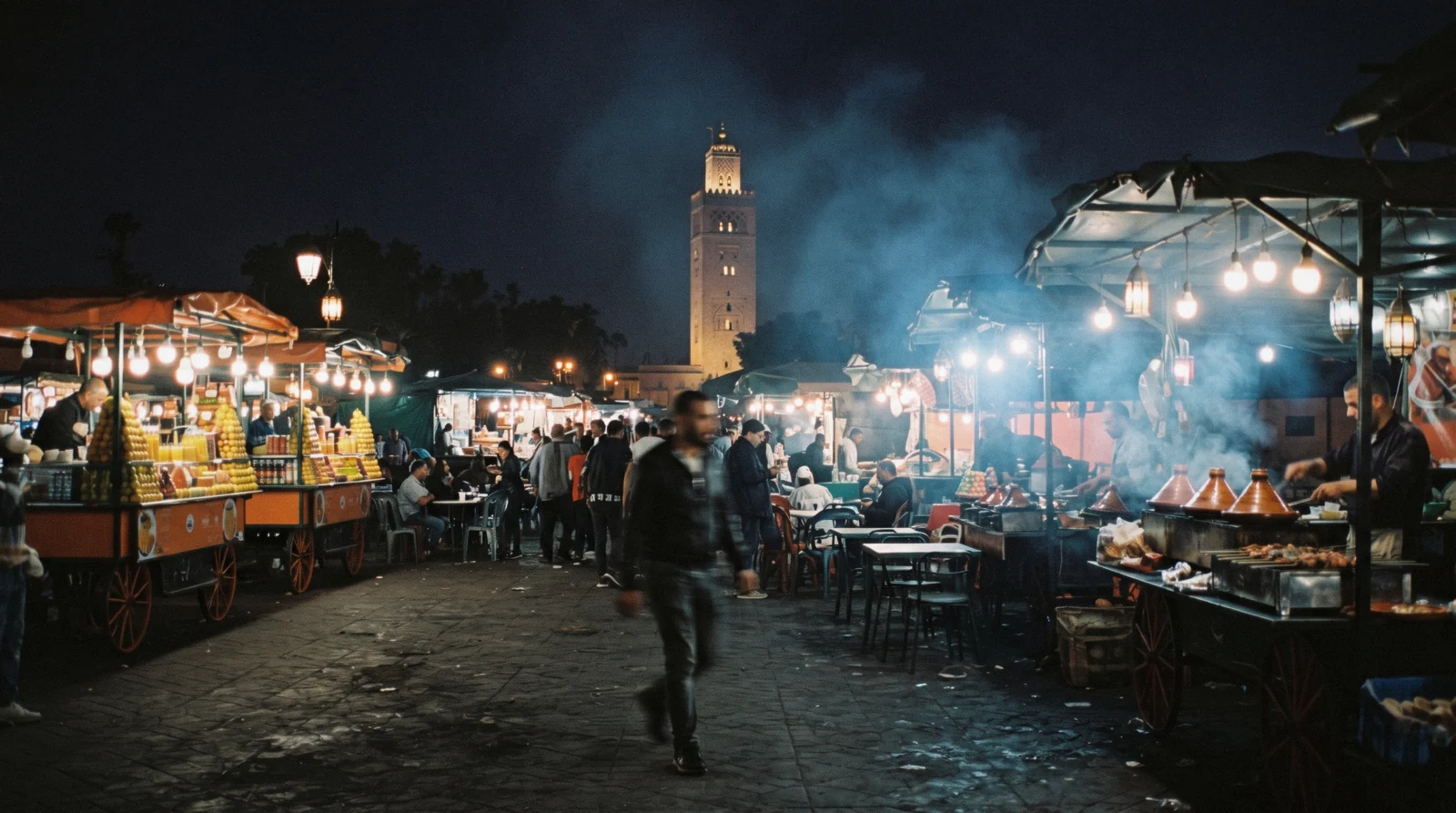
Jemaa el-Fna
Jemaa el-Fna is the open triangular square at the mouth of the Marrakech medina, and the only thing in the city that UNESCO listed for something other than its architecture: the storytellers, musicians, herbalists and food stalls that work it. There is no gate, no ticket and no published opening hour. There is also no published price for anything that happens on the square, which is the single fact that decides how an evening here goes. This page sets out what is official, what is not, and what to agree before you sit down. The ticketed monuments a few minutes away are compared on the Marrakech tickets index, the quarter the square opens into is covered on the medina page, and where Jemaa el-Fna sits in the rest of the city is the homepage.
Quick answer What it costs, when to come, and the one thing to agree first
Jemaa el-Fna costs nothing, has no gate and no published opening hours. UNESCO listed the square itself as Intangible Cultural Heritage under reference 00014, proclaimed a Masterpiece in 2001 and inscribed on the Representative List in 2008. The food stalls set up in the late afternoon, and no Moroccan authority publishes a price for henna, for a photograph with an animal or for a storyteller's circle.
Key takeaways
- Walking on is free at any hour, so the only money question is what you agree before anything starts. What the square's services cost sets out which of them has an official tariff, and the honest answer is that not one of them does
- The square turns over after sunset. The two-and-a-half-hour night food walk is listed at $49.98 and starts at the Cafe de France on the square itself; the three-hour version with a sit-down dinner is the same stalls at $160.41
- Photographing people is governed by a data-protection law rather than a price list, so consent and fee are both agreed first. The Koutoubia minaret six minutes west is free to look at, and the ticketed monuments start at $5.33 (50 MAD) on the tickets index
Key facts
Opening hours
| The square itself, all year | Open–No published closing time |
|---|---|
| The food stalls | Late afternoon–Not stated by any authority |
Closed None. It is a public square with no gate and no closing day.
Admission
- Adult
- Free
- Reduced
- Free
- Free
- Everyone. No authority sells a ticket to the square, and none publishes a tariff for its performers
Planning it
- Time needed
- Not stated by any authority; our routing is 40 minutes in daylight and about two hours after dark
- Address
- Place Jemaa el-Fna, Medina, Marrakech
There is nothing to buy at the edge of Jemaa el-Fna, so this table compares the three ways an evening on the square is actually paid for: on foot for nothing, or on one of the two guided food walks that start on or beside it. The official row is the square itself, which no authority ticket-sells; the tour rows carry the operator's listed price read in Q3 2026.
Are you paying for food, or paying for someone to order it for you?
| What you are paying for | Price | Who sets it | Cancel | Book |
|---|---|---|---|---|
| Walking onto the squareEveryone. There is no gate, no hour and no queue, in daylight or at midnight | Free, and no ticket exists | Nobody. The square is public space run by the Commune de Marrakech; UNESCO lists the cultural space, not an admission | Not applicable | Official site |
| Night street food walk, 2 h 30First evening in the city, and anyone who would rather not choose a stall by pointing | $49.98 | Operator price on GetYourGuide, read in Q3 2026 | Free up to 24 hours before | Check Availability |
| Night food tour with a sit-down dinner, 3 hGroups of at most twelve who want the tastings to end at a table rather than at a stall | $160.41 | Operator price on GetYourGuide, read in Q3 2026 | Free up to 24 hours before | Check Availability |
The gap between the two tour rows is a dinner and a group cap, not a different square: both walk the same stalls and neither includes a monument entry. Doing it yourself costs whatever the stalls charge, paid dish by dish in cash, and no authority publishes those figures either. If the point of the evening is the food rather than the guiding, the cheaper walk buys the same stalls.
The two ways to eat the square with a guide
Both cards below work Jemaa el-Fna and the food streets around it after dark. Prices are the operator's own listing in US dollars, read in Q3 2026; the operator's page shows what is still open on your date.
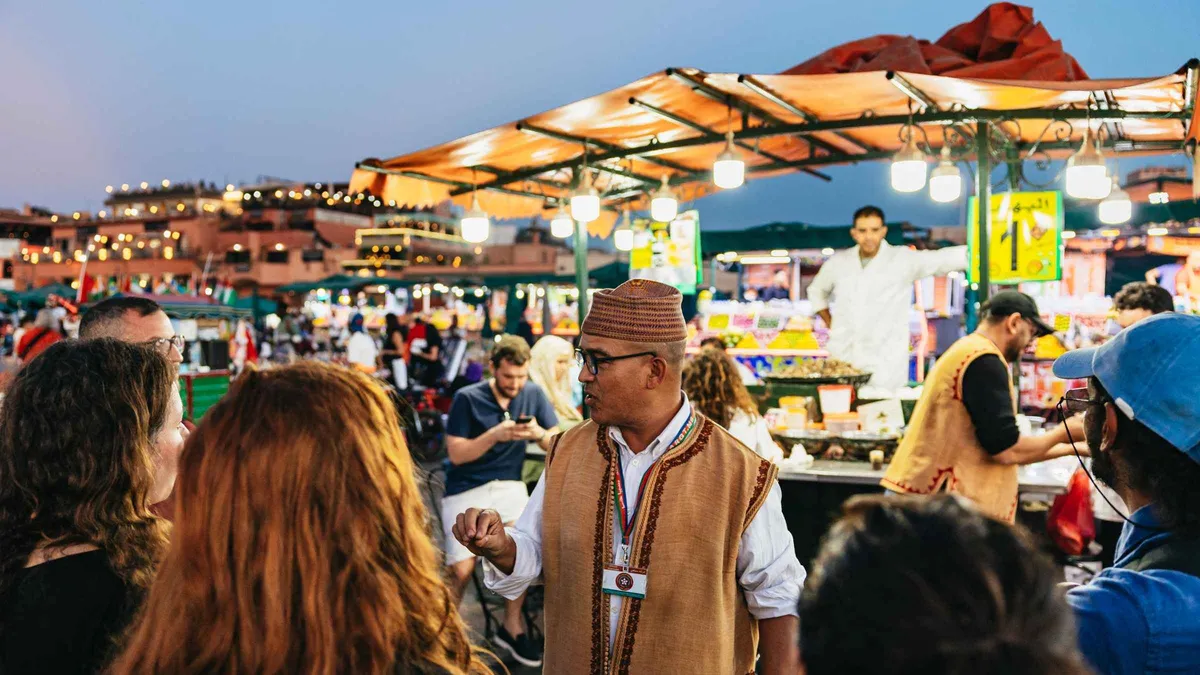 from $49.98
Marrakech: Street Food Tour by Night
listed at $49.98
Two-and-a-half-hour night walk through medina food stalls with tastings and drinks, hotel pickup and drop-off included. Sold as a shared group or a private tour.
Check Availability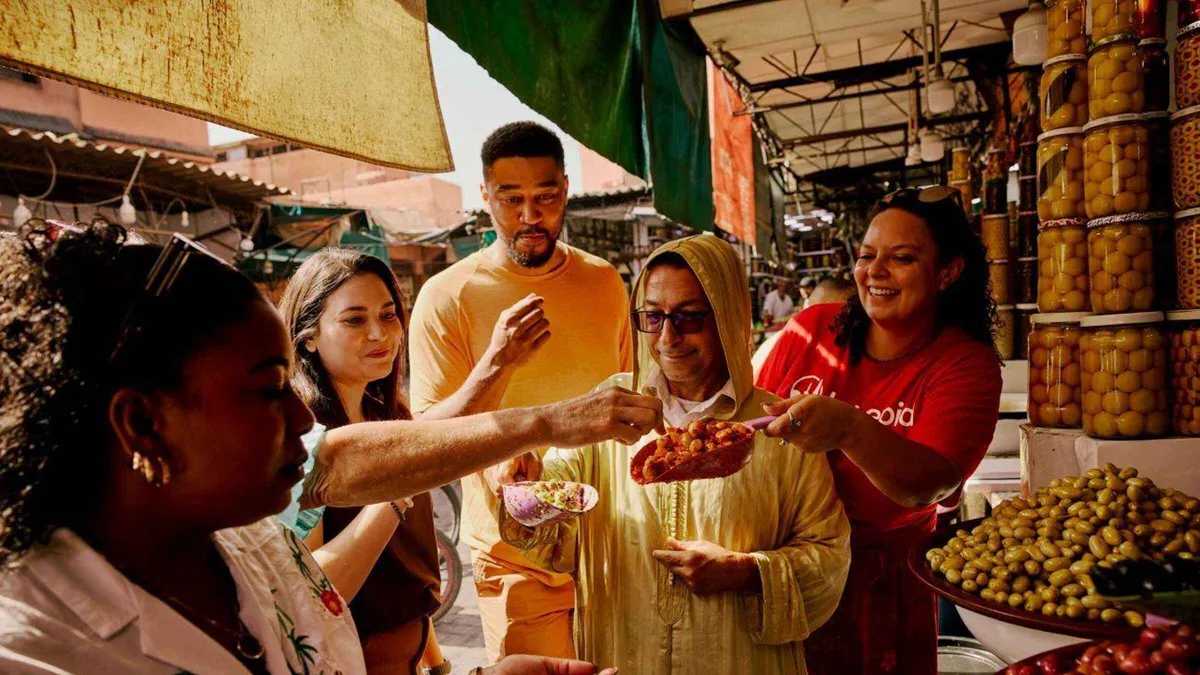 from $160.41
Marrakech: Jemaa el‑Fnaa Night Street Food Tour with Dinner
listed at $160.41
Three-hour evening walk through Jemaa el-Fna and the surrounding food stalls, ending with a sit-down Moroccan dinner on the square. Private group capped at 12; harira, sfenj and mint tea are part of the tastings.
Check AvailabilityPrices, ratings and details are the platform's own, checked in Q3 2026; dollar figures are the listed prices — the platform bills in your account's currency.
What Jemaa el-Fna is, and what UNESCO actually listed
Two separate UNESCO listings apply here and they are routinely merged into one. Keeping them apart explains why the square has heritage status and no ticket office.
The square sits at the entrance of the medina, a rough triangle of open ground where the lanes of the old city meet the avenues of the newer one. UNESCO's Intangible Cultural Heritage file, reference 00014, describes it in its own words: "Located at the entrance of the Medina, this triangular square, which is surrounded by restaurants, stands and public buildings, provides everyday commercial activities and various forms of entertainment... All through the day, and well into the night, a variety of services are offered... water-carrying, fruit and traditional food may be bought." The file also calls it "one of the main cultural spaces in Marrakesh" and "a unique concentration of popular Moroccan cultural traditions performed through musical, religious and artistic expressions."
That listing is about practices, not stones. It was proclaimed a Masterpiece of the Oral and Intangible Heritage of Humanity in 2001 and moved onto the Representative List in 2008. What is protected, in UNESCO's framing, is the halqa, the ring of listeners around a performer, and the trades filling the ground between the rings.
A second and separate listing covers the quarter around it: the Medina of Marrakesh, World Heritage property 331, inscribed in 1985, whose description names "Place Jemaa El Fna, a veritable open-air theatre". Neither status comes with a gate, a ticket or an opening hour, which is why the money here is negotiated one interaction at a time.
The practical shape of the place changes three times a day: open ground and juice carts in the morning, herbalists, henna stools and animal handlers in the afternoon, and from sunset a working kitchen assembled on the tarmac, numbered stalls with trestles, gas bottles, benches and smoke. That last version is the one that ends up on film, and the lanes leaving the north edge run into the souks.
The Square In Eight Dates
Every date below is documented in a source named in the note. Together they explain the two things that surprise a first visitor: that the square is protected, and that almost nothing on it is priced.
-
1070 to 1072
Marrakesh is founded by the Almoravids
UNESCO dates the city's foundation to these years, and its Intangible Heritage file calls the square one of the symbols of Marrakesh since that foundation in the eleventh century.
-
1935
The caleches are put under a permanent municipal order
Arrete municipal permanent number 230 fixes the control regime for the horse-drawn carriages and their teams. It is still the founding text for the trade, and it sets no fare. The main rank is at Place Foucauld, beside the square.
-
December 1985
The medina around the square is inscribed by UNESCO
The Committee's ninth session inscribes the Medina of Marrakesh as property 331 on criteria (i), (ii), (iv) and (v), recommending that Morocco avoid any breaching of the ramparts.
-
2001
The square is proclaimed a Masterpiece
Jemaa el-Fna enters the first proclamation of Masterpieces of the Oral and Intangible Heritage of Humanity.
-
2008
The Masterpiece becomes a Representative List inscription
The cultural space of Jemaa el-Fna Square joins the Representative List of the Intangible Cultural Heritage of Humanity as element 00014.
-
18 February 2009
Loi 09-08 makes a person's image personal data
The data-protection law defines personal data as covering sound and image and requires the subject's consent, which is why a photograph of a performer is a consent question rather than a tariff question.
-
April 2011
The bombing on the square
France Diplomatie records it in its own words: the last bomb attack in Morocco dates to April 2011, the attack on Place Jemaa el-Fna, which cost seventeen people their lives. The same page states that Morocco remains a safe country under the control of its authorities while exposed to the terrorist threat.
-
4 October 2012
Loi 05-12 replaces the guide statute
Published in Bulletin Officiel 6088, it requires every guide to hold an approval and to carry a card and badge, produced on demand. The often-repeated 1956 guide law exists in no official text.
Sources read in Q3 2026: the UNESCO Intangible Cultural Heritage file 00014; World Heritage Committee report SC-85/CONF.008/9 and the ICOMOS evaluation for property 331; France Diplomatie; Loi 09-08 via the CNDP; Loi 05-12 in Bulletin Officiel 6088; and the Medias24 report citing Arrete municipal permanent 230 of 1935.
The square by the hour, and which version you came for
No authority publishes an hour for anything on Jemaa el-Fna, so what follows is a description of the working day rather than a timetable, with the two claims that are sourced marked as such.
Morning is the quiet version most guides skip. The tarmac is largely empty, juice carts line the northern edge, and the square works as a crossing rather than a destination. It is the easiest hour to stand still, to photograph the Koutoubia across open ground and to walk into the souks without a crowd behind you, and it has none of the things the square is famous for.
The middle of the day belongs to the daytime trades: herbalists with jars, tables of teeth and tinctures, henna stools set up under parasols, and the animal handlers. This is when a visitor most often ends up in an unexpected transaction, because a bench, a bird or a hand appears before a price does. Nothing about that stretch is illegal and nothing about it is priced by an authority.
The single rule that helps is the one below in the money section: agree the figure before anything is applied, held or played.
At sunset the square changes character: trestles, gas bottles and lights go up, the numbered stalls open, the music starts and the ground fills. UNESCO's file is the only citable source for that rhythm, putting it as trade all through the day and well into the night. Our reading, not an official figure, is that the stalls are fullest from about an hour after sunset to 22:00, and that the last hour before they break down is the calmest time to eat well.
During Ramadan the eating day shifts entirely to after sunset and the stalls open later; the dates move each year and the best time to visit page carries them.
How Much Time To Give Jemaa el-Fna
No authority states a visit length for a public square, so these three routings are ours, built from the walking distances to the sights around it and from what each version of the square actually offers. All three assume you arrive on foot, because vehicles do not cross it.
The variable is not the square, it is the hour. A daytime pass takes minutes because the ground is mostly empty; an evening takes as long as you are willing to stand in it. The mistake is to treat the daytime crossing as the visit and then to plan the evening somewhere else.
| Routing | What you get | What it skips | Door to door |
|---|---|---|---|
| The daylight crossing | The open ground, the juice carts, the Koutoubia view across the square and the entrance to the souks | Every reason the square is on the UNESCO list: the halqa rings, the musicians, the food stalls | About 40 minutes, including a walk to the Koutoubia esplanade and back |
| The evening on your own | The stalls, the smoke, the music circles, a bench dinner paid dish by dish in cash | Nothing, except that you choose the stall and settle the bill without help | Two hours from arriving before sunset to leaving after the crowd peaks |
| The evening with a guide | The 2 h 30 food walk at $49.98 orders for you across several stalls and the surrounding food streets, hotel pickup included | The wandering. The group keeps moving, and the square is one stop among several | Two and a half hours, or three on the dinner version |
If the trip allows one visit only, make it the evening one; if it allows two, cross in the morning on the way into the souks and come back after dark.
The food stalls: what is documented and what is not
This is the part of the square with the most written about it and the least published about it. Below, the two sourced statements first, then the practical reading that follows from them.
What is documented is UNESCO's own description of the trade: water-carrying, fruit and traditional food bought all through the day and well into the night. That is the whole official record on eating here. There is no municipal stall register online, no hygiene rating, no price list and no opening time.
The numbers painted on the awnings are the operators' own signage, not a rating.
What is documented separately is the food itself. Couscous was inscribed on the UNESCO Intangible Cultural Heritage list in 2020, in a joint file submitted by Algeria, Mauritania, Morocco and Tunisia; the file calls it "a dish replete with symbols, meanings and social and cultural dimensions all linked to solidarity, conviviality, sharing meals and togetherness". The national tourist office names tanjia as the staple dish of Marrakech, traditionally prepared with lamb or veal in a terracotta jar, and harira as the soup of pulses, tomatoes, pasta and flour tied to Ramadan.
Those are the three things worth ordering that an official source will actually vouch for.
The practical consequence of all that silence is simple. Ask the price of each dish before it is put down, keep the ordering to what you asked for, and treat anything that arrives unrequested as an offer rather than as part of the bill. Cash is the norm: no authority states that stalls take cards, and the dirham is a closed currency you have to change on arrival, which the costs page explains.
A guided walk removes that whole negotiation, which is what the $49.98 on the night food walk is buying. This page names no stall and no restaurant on the square: there is no MICHELIN Guide restaurant selection for Morocco at all, and no stall publishes its own hours or prices.
What the square's services cost, and who sets the price
This is the table this page exists for. Each row is a transaction a visitor is offered on Jemaa el-Fna, with what an authority actually publishes about its price. We searched the Commune de Marrakech's own site, the wilaya, the Ministry of Culture ticketing platform and the national tourist office in Q3 2026; the right-hand column is what to do given the answer.
| On the square | Published price | Who would set it | What to do |
|---|---|---|---|
| Walking on, standing, listening to a halqa circle | Free. No admission exists | Nobody. Public space under the Commune de Marrakech | Nothing. Performers pass a hat and a coin or two is the convention, not a fee |
| Henna on the hand | Not published by any authority | No tariff order exists at commune, prefecture or ministry level | Agree the figure and the design before a cone is opened, or decline before a hand is taken |
| A photograph with a monkey, a snake or a water-seller | Not published by any authority | No authority documents the practice at all, let alone prices it | Consent runs both ways: Loi 09-08 article 4 requires the subject's consent, and the handler will want a fee. Settle both first |
| Food at a numbered stall | Not published. No stall register or price list exists online | The stall operator | Ask the price per dish before anything is served, pay in cash, keep the order to what you asked for |
| A caleche from the Place Foucauld rank | Not published. No tariff order is posted by the commune | The Commune de Marrakech regulates the trade under a 1935 permanent order but publishes no fare | Agree the price and the length of the circuit before boarding; there is no posted figure to appeal to |
| A guide who approaches you on the square | Not published. Guide tariffs are set for guidance only, by the guides' own federation | Loi 05-12 licenses the guide, and the federation issues indicative rates | Ask for the professional card and badge, which article 10 requires the guide to carry and produce on demand |
Six transactions, and not one of them has a price published by a Moroccan authority. That is not an oversight in this guide; it is the finding. Any figure you read elsewhere for henna, a photograph or a caleche hour comes from a blog or an operator, and we do not reprint those as though a city hall stood behind them. The one number a law does back is zero: the square itself is free.
Five Things Most Visitors Do Not Know About Jemaa el-Fna
Five findings from the official record, each of which changes something practical about an evening here. Every one carries the source it came from.
- The square is UNESCO listed, but not as a monument. It is an Intangible Cultural Heritage element, reference 00014, proclaimed a Masterpiece in 2001 and inscribed on the Representative List in 2008. What is protected is the performing and trading practice, which is why there is nothing to buy a ticket to [UNESCO Intangible Cultural Heritage file 00014, read in Q3 2026]. - No authority anywhere publishes a price for henna, a photograph or a storyteller. The Commune de Marrakech's transport and council-decision sections were crawled for this guide and carry parking, road and bus-station items only; the Ministry of Culture platform sells five Marrakech monuments and nothing on the square [ville-marrakech.ma and e-services.minculture.gov.ma, checked in Q3 2026]. - A photograph of a person is a legal question, not a tariff question. Loi 09-08 defines personal data as covering sound and image, and its article 4 states that data may be processed only where "la personne concernee a indubitablement donne son consentement". The regulator, the CNDP, can fine between 10,000 and 200,000 dirhams [Loi 09-08, dahir 1-09-15, as published by the CNDP]. - The bogus-guide problem is documented by a foreign ministry, not a local one. The UK FCDO puts it as: "It is common for people posing as official tourist guides to harass tourists.
If you use a guide in a historical district (medina quarter), make sure they have an official badge and permission from the local authority." The badge itself is required by article 10 of Loi 05-12 [gov.uk Morocco travel advice; Bulletin Officiel 6088]. - The one Marrakech-specific scam any authority documents is not on the square at all. France Diplomatie describes fake travel agencies in Marrakech offering discounted trips or VIP contracts as compensation for a service that fell short, taking an initial payment or a card imprint to check solvency and then making fraudulent transfers from the customer's account. It names no henna artist and no animal handler [France Diplomatie, Maroc, conseils aux voyageurs].
On The Square: What To Do, And What Not To
Each line is a decision argued somewhere above, in the form you can act on this evening.
Do
- Agree every price out loud before anything starts: the henna cone, the photograph, the caleche circuit, the dish
- Ask for the meter in a petit taxi at the edge of the square, because the meter is the only figure the law actually requires
- Ask any guide who approaches for the professional card and badge that article 10 of the guide law obliges them to carry
- Keep bags closed and in front of you in the crush, which is exactly the situation the advisories describe
Don't
- Do not let a hand be taken, an animal be placed or an instrument be played before a figure is agreed. The transaction has begun by then
- Do not photograph a performer, a water-seller or a child without asking. Consent is a legal requirement here, not a courtesy
- Do not quote a price you read on a blog back to anyone: no municipal tariff exists to appeal to, so the number carries no weight
- Do not follow an unsolicited offer to lead you to a tannery or a shop through the lanes; the bogus-guide warning is the one thing the advisories are blunt about
Safety on the square, in the advisories' own words
Two foreign ministries publish text that bears directly on this square. Both are quoted rather than paraphrased, because the paraphrases circulating online are stronger than the originals.
France Diplomatie is the only ministry with Marrakech-specific wording. On street crime it states that bag-snatching is regularly reported and that heightened vigilance is required in large cities such as Casablanca or Marrakech, where thieves on motorbikes ride along the pavements to snatch handbags and mobile phones. That is a description of a crowded pavement at night, which is what the edges of Jemaa el-Fna are.
Walk with the bag on the inside shoulder and the phone out of sight while you move.
The UK FCDO adds the medina-wide picture: petty crime is common in historical districts, including pickpocketing, bag-snatching and drive-by motorcycle theft of visible jewellery and handbags, with caution advised when asking directions and using ATMs. None of that is a reason to avoid the square; it is a reason to arrive with the habits you would take into any dense night market.
On the question people actually search for, the record is specific. France Diplomatie states that the last bomb attack in Morocco dates to April 2011, the attack on this square, in which seventeen people died, and adds in the same passage that Morocco remains a safe country under the control of its authorities while exposed to the terrorist threat. Both halves were published together, so both are printed here.
Emergency numbers: 190 police, 150 ambulance, and a Marrakech tourist police line on 05 24 38 46 01, with the conflicting official sets set out on the safety page.
One caution that is easy to miss: methanol in counterfeit alcohol is the contamination risk the FCDO does raise for Morocco, in blunt terms, noting deaths and serious illness and that it cannot be identified by taste or smell.
Getting to the square, and getting away from it after dark
The square is the point every route in the medina converges on, which makes arriving easy and leaving at midnight the part worth planning. Fares below are the last officially published figures, with the caveat each one carries.
On foot is the default and usually the only option, because vehicles do not cross the square. From the northern medina you walk south through the souks to the top edge; from the Kasbah and the southern monuments you come up past Place des Ferblantiers. Little in the medina is more than twenty minutes away on foot.
By bus, the network changed hands recently and the published record has not caught up. Supratours, a subsidiary of the national rail operator, took the Marrakech urban network over from ALSA after twenty-six years, so every ALSA fare still circulating online predates the handover. The last officially published urban fare is 4 MAD, about $0.43, and no post-handover table exists.
Treat it as the last figure published rather than a current price, and read getting around Marrakech first.
By taxi, the meter is the whole story. The compulsory-meter rule rests on the dahir of 12 November 1963, restated by circulars in 2022 and 2024, but the Marrakech order that would give the pick-up charge and the per-kilometre rate is published nowhere. Petits taxis carry three passengers and stay inside the city.
Ask for the meter, and if it is refused, take the next car. Ride-hailing is a dead end: Uber withdrew from Morocco, Careem was challenged before the competition council, and inDrive and Bolt operate outside the legal framework.
The caleche rank at Place Foucauld sits immediately beside the square, and the trade is genuinely regulated: horses carry a branded number on the left fore hoof, a bracelet and a neck microchip, the fleet faces three mandatory inspections a year with SPANA and the royal horse-breeding body, and 148 drivers were issued official uniforms. What the commune does not publish is a fare. For the airport, the airport transfer page sets out the two conflicting official figures and the bus to Gueliz.
Jemaa el-Fna on the map, with what is walkable from it
The square, the Koutoubia esplanade to the west, and the ticketed monuments within a quarter of an hour on foot. Coordinates come from the Ministry of Culture ticketing platform, from the venues' own sites and from Wikidata; walking times are our estimates from those distances and run long, because the lanes do not go straight.
Next stop from the square
Three places you can reach on foot from the edge of Jemaa el-Fna, with our own walking estimates from the mapped distances.
Koutoubia Mosque
Straight west across the open ground and along the avenue. The esplanade and gardens are free and the minaret is the one thing visible from most of the medina; the interior is closed to non-Muslims, which the Koutoubia page explains with the ministry text that states it.
6 min walkThe souks
The lanes leaving the north edge of the square are the entrance to the covered markets, and they are free to walk. The souks page covers what is documented about their hours, which is very little, and what to expect on price.
2 min walkLe Jardin Secret
A rebuilt riad garden on Rue Mouassine with published hours, a published tariff of 100 MAD, about $10.65, and the fullest accessibility statement of any venue in the city. It is the easiest quiet half hour within reach of the square.
8 min walkJemaa el-Fna questions
Do you have to pay to enter Jemaa el-Fna?
No. The square is public space with no gate, no ticket and no admission price. What costs money is what you agree with a stall, a henna artist, a photographer or a caleche driver, and none of those has a published tariff, which is what the services table sets out. If you want the food without the negotiation, the night street food walk is listed at $49.98.
What does Jemaa el-Fna mean in English?
Nobody can tell you for certain, and the honest answer is more interesting than the confident ones. Jamaa in Arabic means congregation or mosque; fna carries both the sense of an open area in front of a building and the sense of extinction or ruin, so the readings run from the plain gathering place to the assembly of the dead. The explanation historians endorse is the ruined mosque: the Saadian sultan Ahmad al-Mansur began a monumental Friday mosque in the middle of this ground and abandoned it unfinished, and the chronicler as-Sa'idi records that its intended name was jamaa al-hna, the Mosque of Tranquility, which popular irony turned into the Mosque of ruin. The account is the English Wikipedia article on the square, which is the only one of the ten pages ranking for this question that cites historians at all; UNESCO's own file, quoted throughout this page, does not translate the name.
Why is Jemaa el-Fna famous?
Because UNESCO listed the square's living practice rather than its buildings: proclaimed a Masterpiece of the Oral and Intangible Heritage of Humanity in 2001 and inscribed on the Representative List in 2008 as element 00014. UNESCO calls it one of the main cultural spaces in Marrakesh and a unique concentration of popular Moroccan cultural traditions. It also sits inside the World Heritage medina, covered on the medina page.
Is Jemaa el-Fna safe at night?
The published risks are theft rather than violence. France Diplomatie reports bag-snatching in Marrakech, with thieves on motorbikes riding along pavements to take handbags and phones, and the FCDO lists the same for medina quarters. The French page records the April 2011 bombing on this square, seventeen dead, as the last bomb attack in Morocco, and says the country remains safe and under the control of its authorities. Police 190, ambulance 150; the safety page has the full set.
What time do the food stalls on Jemaa el-Fna open?
No authority publishes a time. UNESCO records trade all through the day and well into the night, the stalls are assembled in the late afternoon, and our reading is that they are fullest from an hour after sunset to about 22:00. During Ramadan the eating day shifts to after sunset. The guided walk works to the operator's own schedule.
How much does henna on Jemaa el-Fna cost?
Nobody official will tell you, and that is the answer worth having. The Commune de Marrakech site, its council decisions, the prefecture and the ministry were all searched for a tariff and none exists for henna, for a photograph with an animal or for a storyteller's circle. Agree the figure and the design before a cone is opened, decline before a hand is taken, and treat any number quoted online as a memory rather than a rate.
Can you take photographs of the performers on Jemaa el-Fna?
Only with consent, and that is the legal position rather than an etiquette rule. Loi 09-08 defines personal data as covering sound and image and its article 4 requires that the person concerned has unambiguously given consent; the regulator can fine from 10,000 to 200,000 dirhams. The UK FCDO puts the same thing plainly: always ask permission before taking pictures of people, especially children. In practice a handler or performer will want a fee as well, so settle both before the shutter.
Where the square fits in a day in Marrakech
Treat Jemaa el-Fna as the hinge of the day rather than as a stop on it. The ticketed monuments south and north of it keep office hours: the Ministry of Culture sites publish 9:00 to 17:00, the Medersa Ben Youssef runs 9:00 to 19:00 and Le Jardin Secret closes between 18:00 and 19:30 depending on the month. All of them are shut by the time the square is at its best, which is why a day that ends here works and a day that starts here wastes the only hours the monuments are open.
The routing that follows from that: monuments in the morning and early afternoon, the souks in the late afternoon while the light is still good in the lanes, and the square from sunset. On a Friday, note that Moroccan nationals enter the Ministry monuments free, which makes them busier, while nothing changes on the square itself. The tickets index sets out all four ticket authorities and the two-tier tariff, and the medina page puts the quarter around the square in order.
Jemaa el-Fna on Film: The Square Before And After Dark
Three walk-throughs that show what the square actually looks like at each of its hours, which is the fastest way to decide when you want to be standing on it.
Jemaa El Fna | The international symbol of Marrakech, Morocco |4k|
A steady 4K pass across the square and its edges, useful for the daytime version most guides skip.
Video: Morocc_OH!MARRAKECH MOROCCO After Dark | jemaa El-Fna Walking Tour [4K]
The after-dark walk, filmed at the hour the stalls and the music circles are at their fullest.
Video: Discover With JoeMoroccan Street Food, Night Market Tour in Marrakesh, Morocco (Jema El Fnaa Square)
A stall-by-stall look at what is actually cooked and served on the square after sunset.
Video: Mark WiensVideos load from YouTube only when you press play.
Reviewed Q3 2026 (July–September 2026); next review Q4 2026. Prices, hours and terms are set by the venue or operator and confirmed at checkout.
We may earn a commission if you book through one of our links, at no extra cost to you. Full affiliate disclosure