 Marrakech Guidebook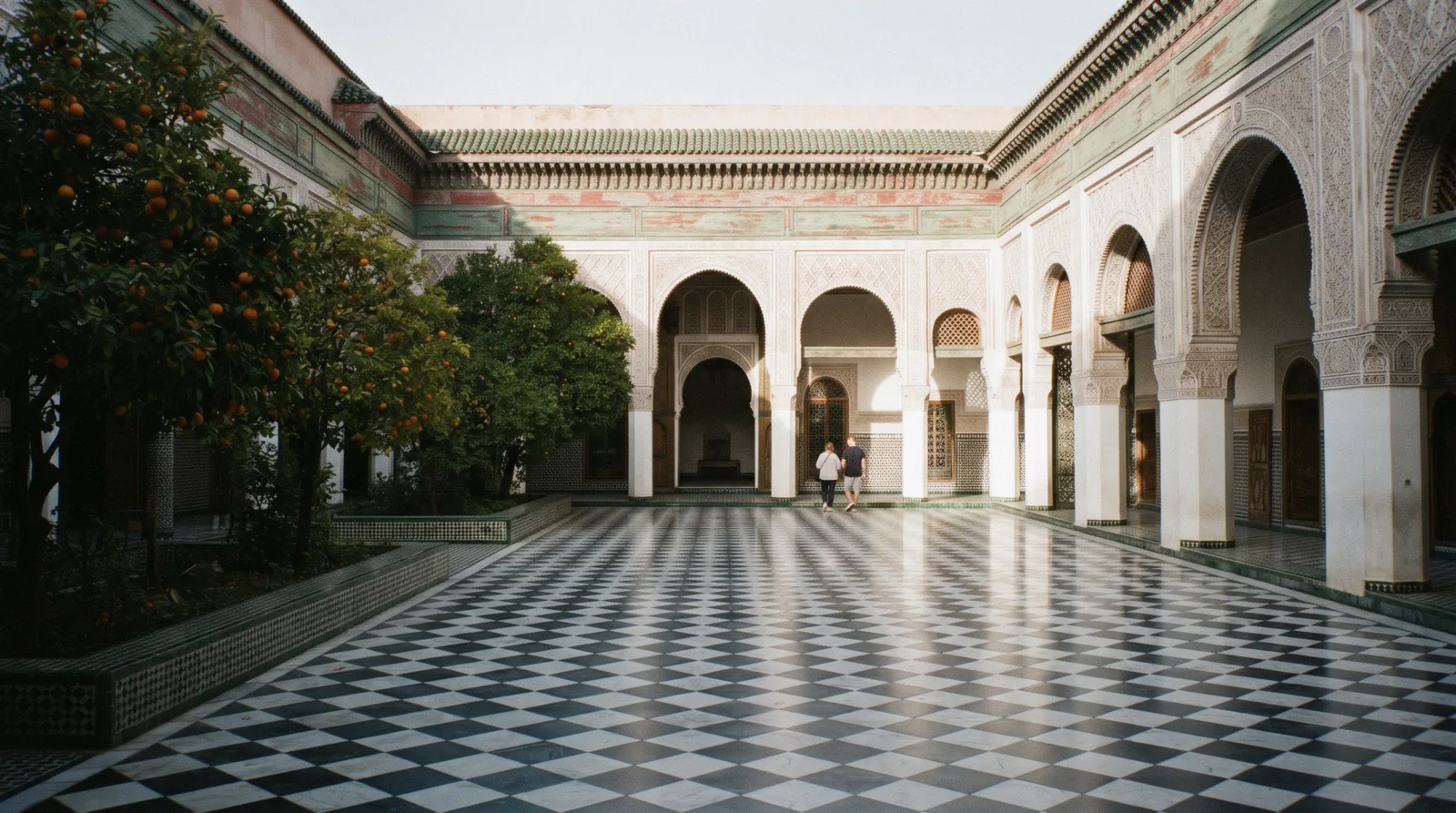
Bahia Palace
The Bahia Palace is the vizier's residence in the south-east corner of the Marrakech medina, eight hectares of courtyards, painted cedar ceilings and zellij built in two phases in the second half of the nineteenth century. It opens 09:00 to 17:00 and the Ministry of Culture charges a foreign adult $10.65 (100 MAD) at the same window where a Moroccan pays $3.20 (30 MAD). This page covers the hours, the history, the rooms that repay a slow walk and the door you queue at; prices, guided entry and how to buy sit on the Bahia Palace ticket page, and the wider trip starts at our Marrakech guidebook.
Quick answer Hours, what a foreign adult pays, what to see, how long, in four lines
The Bahia Palace opens 09:00 to 17:00 every day, and the Ministry of Culture publishes no closing day at all. A foreign adult pays 100 MAD at the gate or on the Ministry's own platform, which is $10.65; a Moroccan or resident adult pays 30 MAD.
Key takeaways
- The gate and the official online shop sell the same ticket at the same price, so there is nothing to book weeks ahead; the full price grid and the guided alternatives are on the Bahia Palace ticket page
- A ninety-minute guided visit with entry handled was listed below the gate ticket when we read the card: the one case on this site where a guide costs less than a door
- Give it 45 minutes for the four courtyards and 90 if you intend to read the ceilings; the Ministry states no visit length, so the routings below are ours
- It stands eight minutes on foot from the ruins of El Badi and five from Dar Si Said, which is why most visitors do the three in one morning
Key facts
Opening hours
| Daily, as published by the Ministry | 09:00–17:00 |
|---|
Closed Not stated. The Ministry publishes no weekly closing day for the palace
Admission
- Adult
- $10.65 (100 MAD) foreign adult; $3.20 (30 MAD) Moroccan or resident adult
- Reduced
- $5.33 (50 MAD) foreign child 7 to 13; $1.07 (10 MAD) Moroccan or resident child 7 to 13
- Free
- Persons with reduced mobility; Moroccan nationals every Friday and on the first day of national and religious holidays
Planning it
- Time needed
- Not stated by the Ministry; our routing: 45 minutes for the courtyards, 90 minutes if you read the ceilings
- Book ahead
- Optional — walk-up usually fine
- Address
- Avenue Imam El Ghazali, off Riad Zitoun el-Jdid, Medina, Marrakech
Five ways through the same gate, priced from the Ministry of Culture's own ticket page for the Bahia and from the GetYourGuide cards listed for this monument. The Ministry sells entry and nothing else; the cards below add a licensed guide and, in three cases, further monuments on the same walk. Listed prices move with the date, so treat a card price as what you pay only once the checkout shows it.
Are you paying for a door, or for someone who can read the ceilings above you?
| Option | Price | Includes | Cancel | Book |
|---|---|---|---|---|
| Ministry of Culture ticket, online or at the gateThe default, and the only row that is not somebody's resale. Bring dirhams if you buy at the window | $10.65 (100 MAD) foreign adult; $5.33 (50 MAD) foreign child 7 to 13; $3.20 (30 MAD) Moroccan or resident adult; $1.07 (10 MAD) Moroccan or resident child | Entry only. No guide, no audio, no timed slot | Not stated | Official site |
| Guided visit, 1 h 30, entry handled by the guideAnyone comparing on price: it was listed under the gate fare when we read it, and it still includes a guide | Listed at $8 | Palace entry plus a licensed guide, then free time inside | Free up to 24 hours before | Check Availability |
| Four-hour guided walk: this palace, the Saadian Tombs, the souksVisitors doing the whole Kasbah and Mellah side in one go, and happy to pay 100 MAD at each gate | Listed at $17.58 | Licensed guide and the route; monument entries paid in cash on site | Free up to 24 hours before | Check Availability |
| Three-hour walk: this palace, the Saadian Tombs, the Koutoubia outsideA shorter version of the same circuit for anyone with only a morning | Listed at $17.44 | Licensed guide; 100 MAD per adult paid at each monument gate | Free up to 24 hours before | Check Availability |
| Four-hour walk: this palace, the Ben Youssef Madrasa, the medinaPeople pairing the palace with the madrasa rather than with the Kasbah monuments | Listed at $17.58 | Licensed guide across two ticketed monuments and the souks; entries separate | Free up to 24 hours before | Check Availability |
One gate, four tariffs. None of the guided cards includes the 100 MAD entry except the first, whose listed price sat below the gate fare. Card prices are what GetYourGuide listed when we read them; the entrance fees are the Ministry's own published tariff. Official ticket-office links on this site are never affiliate links.
Guided visits that go inside the Bahia
Every card links to the operator's own page, where the calendar shows what is still open on your date. Prices are the figures the platform listed when we read the cards; ratings and review counts are the operator's own.
 from $8
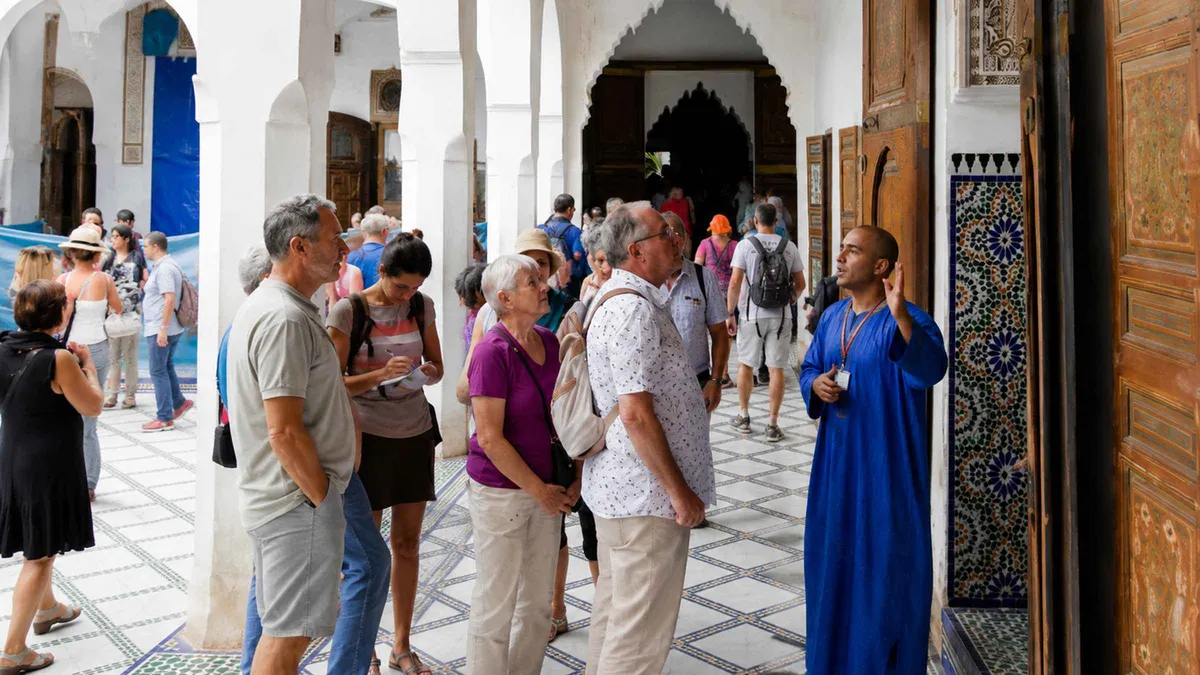
Marrakech: Bahia Palace Guided Tour with Skip-the-Line Entry
listed at $8
Ninety-minute guided visit of Bahia Palace with the guide handling the entry line, then free time inside. Some sections of the palace are under renovation.
Check Availability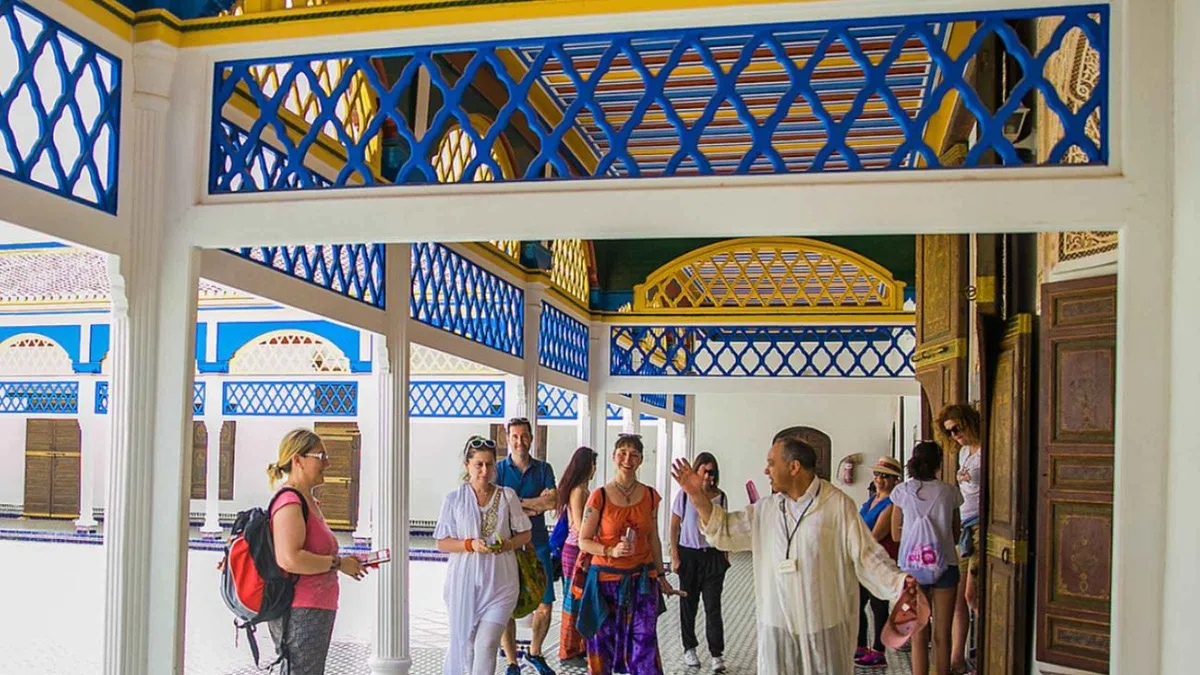 from $17.58
Marrakech: Bahia Palace, Saadian Tombs, Souk and Medina Tour
listed at $17.58
Four-hour licensed-guide walk covering Bahia Palace, the Saadian Tombs, the souks and the medina, with a WhatsApp reminder the day before. Monument tickets are paid in cash on site: 100 MAD per adult per monument, 30 MAD ages 7-13.
Check Availability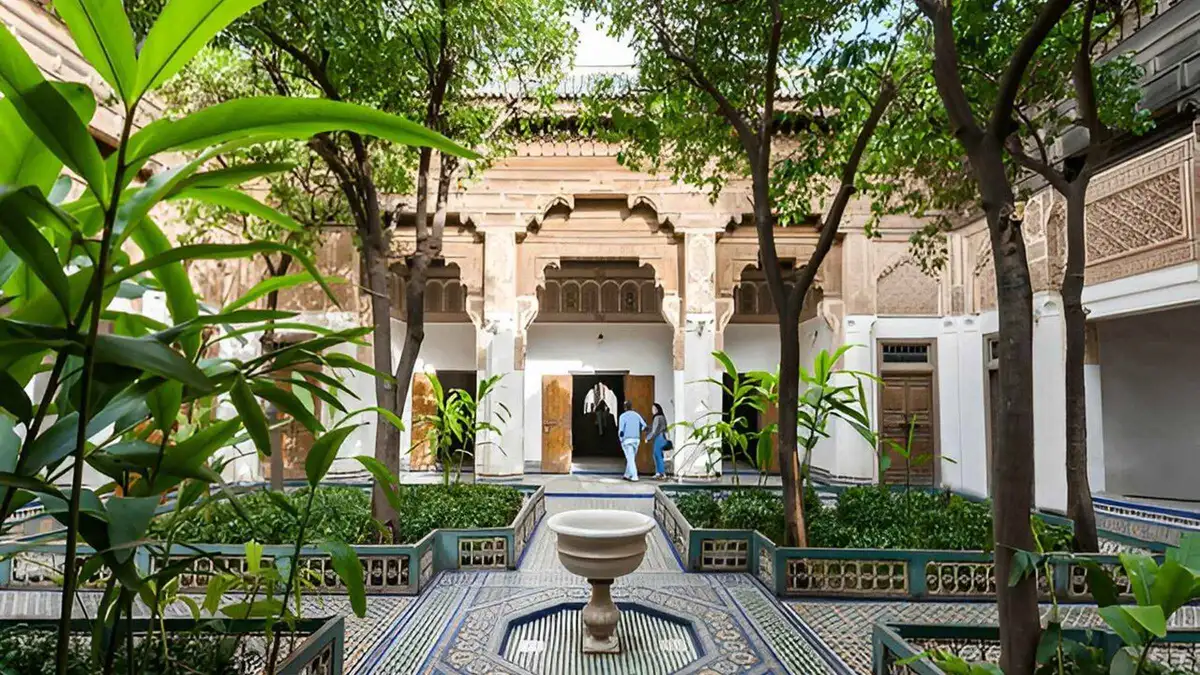 from $17.44
Marrakech: Bahia Palace, Saadian Tombs, & Koutoubia Mosque
listed at $17.44
Three-hour guided walk taking in Bahia Palace, the Saadian Tombs and the Koutoubia from the outside. Monument entrance fees are paid separately in cash: 100 MAD each for Bahia Palace and the Saadian Tombs.
Check Availability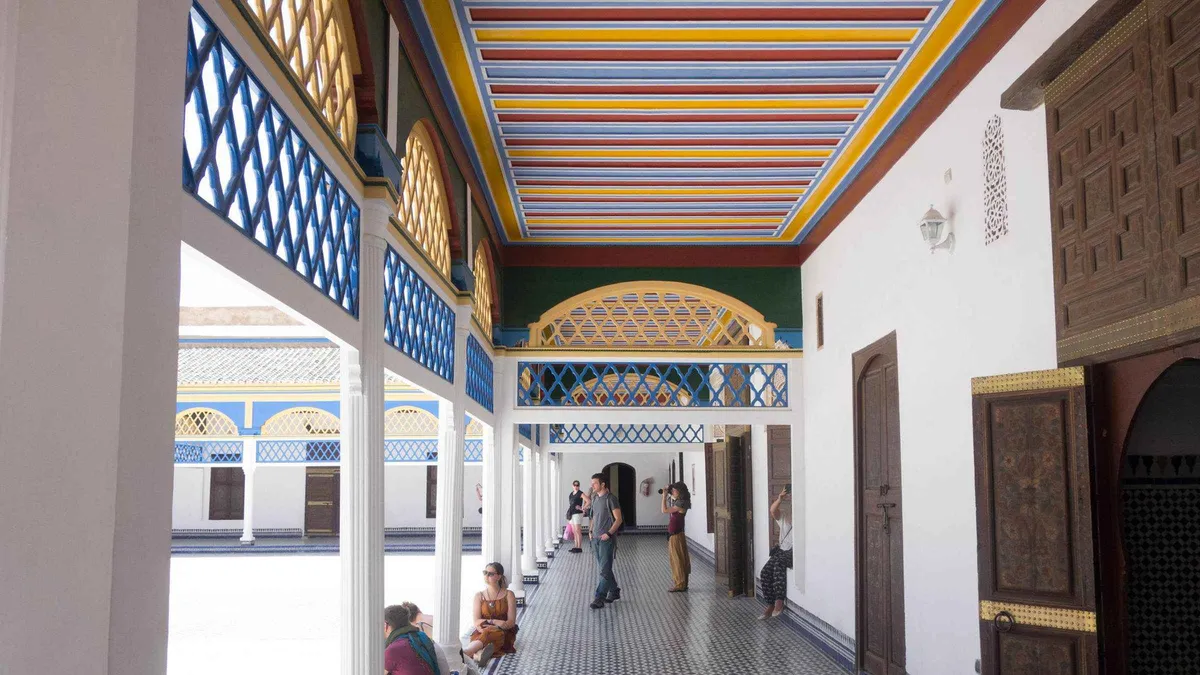 from $17.58
Marrakech: Bahia Palace, Madrasa Ben Youssef and Medina Tour
listed at $17.58
Four-hour guided walk through Bahia Palace, Madrasa Ben Youssef and the medina with a licensed guide. Entry is paid in cash at the door: 100 MAD for Bahia Palace and 50 MAD for the madrasa.
Check Availability from $16.85
Marrakech: Saadian Tombs & Bahia Palace, Medina Guided Tour
listed at $16.85
Four-hour guided walk linking the Saadian Tombs, Bahia Palace and the medina lanes, with pickup available. Runs in several languages and is sold as shared or private.
Check Availability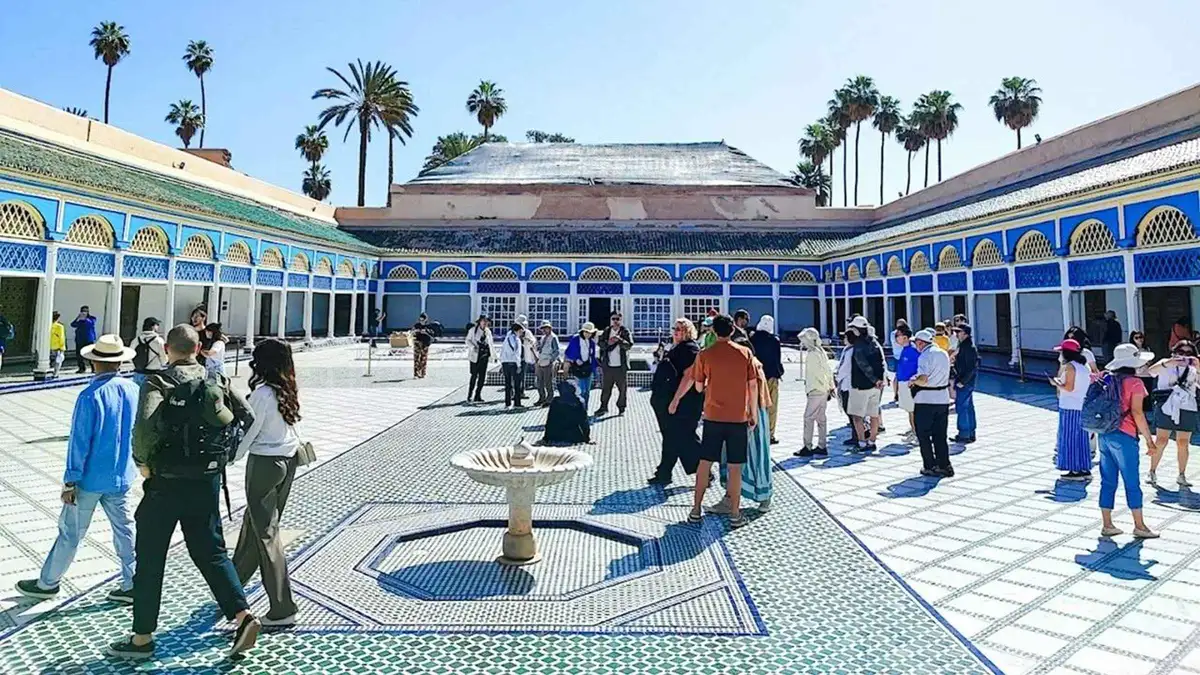 from $20.92
Marrakech: Bahia Palace, Saadian Tombs & Medina Walking Tour
listed at $20.92
Three-hour private walking tour of Bahia Palace, the Saadian Tombs and the medina with a local guide and water. Monument tickets are not included and are paid in cash at each gate.
Check AvailabilityPrices, ratings and details are the platform's own, checked in Q3 2026; dollar figures are the listed prices — the platform bills in your account's currency.
What the Bahia Palace Is: A Vizier's House, Not A Sultan's
Nobody royal ever lived here. The Bahia was built by two men who ran Morocco on the sultan's behalf, and the house is a record of how much power a chamberlain could accumulate in one lifetime.
The Ministry of Culture describes the monument in one sentence: built in two phases over an area of 8 hectares during the second half of the 19th century, with courtyards, gardens, salons and outbuildings in marble, moucharabieh, zellij, stained glass, carved and painted wood and stucco. That is the whole official description: no room list, no plan, no route and no visit length.
The first phase belongs to Si Moussa, a chamberlain who rose to grand vizier under Sultan Sidi Muhammad ben Abderrahmane. Two chambers beside the garden carry an inscription dating them to 1866 and 1867, the oldest datable fabric a visitor walks past. The second phase belongs to his son Ba Ahmed, who held the same office and expanded the house between 1894 and 1900.
The marble grand courtyard, where every photograph is taken, is dated 1896 to 1897: the part that looks like the heart of the palace is the newest room in it.
Al-Bahia means "the brilliant", and it was reportedly the name of Ba Ahmed's favourite wife rather than a description of the building. The architect of the expansion was Muhammad ibn Makki al-Misfiwi, 1857 to 1926, one of the few nineteenth-century Moroccan builders whose name survives attached to a building you can walk into.
Why the rooms are empty
Visitors leave disappointed that there is no furniture, and the reason is a single afternoon. Ba Ahmed died in 1900 and within hours Sultan Abdelaziz reportedly ordered the palace looted, so what you walk through is a shell emptied deliberately and never refilled: the ceilings, the doors and the tilework carry the whole visit. In 1908 Madani el-Glaoui took control and added upper floors; from 1912 it housed the French resident-general, and that occupation is why the building was kept in repair rather than left to fall in like the ruin across the Mellah.
The Bahia In Eight Dates
Every date below is argued somewhere on this page; the list is here so the house reads in order rather than in themes.
-
1860s
Si Moussa starts building
A chamberlain turned grand vizier buys ground in the south-east of the medina, beside the Mellah. The quarter was already dense, which is why the palace grew sideways in courtyards instead of upwards.
-
1866–1867
The dated chambers
An inscription in the two chambers either side of the garden dates them to these years: the oldest fabric in the complex carrying a date.
-
1894–1900
Ba Ahmed doubles it
Si Moussa's son, grand vizier and effectively regent for the boy sultan Abdelaziz, expands the house into the eight-hectare enclosure the Ministry still describes.
-
1896–1897
The grand courtyard is paved
The marble chequer everyone photographs, 50 metres by 30, belongs to this campaign. The most famous space is also the newest.
-
1898
Lalla Zaynab's apartment
Ba Ahmed builds a private apartment for his first wife. These small, cool rooms are the part of the palace that still reads as a home rather than a stage.
-
1900
Ba Ahmed dies and the palace is stripped
Sultan Abdelaziz reportedly orders the looting within hours of the death: the afternoon that emptied every room you walk through.
-
1908
The Glaoui takes it
Madani el-Glaoui, the Atlas warlord whose family ran southern Morocco, takes control and adds upper floors.
-
1912
The residence of the French resident-general
With the protectorate the palace becomes the home and office of the man who governed Morocco for France, which is why it was kept in repair. The same treaty year built the boulevards of Gueliz.
Construction dates, the inscription years, the architect, the looting and the protectorate use are as recorded on the Wikipedia article for the palace (en.wikipedia.org/wiki/Bahia_Palace); the eight-hectare figure and the two-phase framing are the Ministry of Culture's own words on its ticket page for the monument.
What To See Inside, In The Order The Palace Gives It To You
The route is one-way and largely fixed by the doors that are open, so the question is not what to skip but what to slow down for. Four spaces carry the visit.
The small riad garden. A long corridor opens into a planted courtyard with a fountain, banana and citrus, rooms on all four sides. It is the quietest space in the palace because groups walk through it towards the marble, and the painted cedar doors here are the best preserved in the building, close enough to see the brush marks.
The grand courtyard. Fifty metres by thirty, an Italian marble chequer inside a painted cedar arcade. No planting and no shade in the middle, which is the point: it was built to be crossed in procession, not sat in. At midday it is the hottest place on the site and where every coach group stops, so walk the arcade rather than the open.
The council chamber and the great rooms. The reception rooms off the courtyards are where the ceilings are: painted cedar in geometric coffers, muqarnas plaster in the corners, stained glass in the upper lights, zellij dados at shoulder height. Nothing is labelled and nothing is roped, so the only limit on how long you stand is your neck.
The apartments. The smaller courtyards on the far side, including the rooms built for Lalla Zaynab in 1898, are cooler, lower and domestic. On half an hour this is the part to cut, and it is also the part most worth having if you can spare the time.
The renovation question
One of the operator listings for the palace states plainly that some sections are under renovation. The Ministry publishes no schedule of works and no list of open wings, so the honest answer is that parts of it usually are, that nobody official says which, and that the main courtyards stay open. Ask at the window before you pay if a particular room decides your morning.
How Much Time To Give The Bahia Palace
The Ministry states no visit length for any of the four monuments it sells in Marrakech, which is unhelpful for a place people plan a morning around. These three routings are ours, built from the fixed one-way route and from where the crowd actually stands.
The variable is not the size of the palace, it is whether you look up. Walked at the pace the route allows, the complex takes half an hour and you will remember the marble and nothing else. The ceilings are why the building is famous, and they cost time because nothing is labelled and there is nowhere to sit.
Whichever routing you pick, arrive at 09:00: the first coach groups reach the gate after 10:00.
| Routing | What you get | What it skips | Door to door |
|---|---|---|---|
| The short walk | The small riad garden, the grand courtyard, two reception rooms with the painted ceilings | The apartments on the far side and every second courtyard | About 45 minutes including the ticket window |
| The full visit | All four main courtyards, the council chamber, Lalla Zaynab's apartment, the painted doors twice over | Nothing that is open on the day | About 90 minutes, longer if you photograph ceilings |
| With a guide | The ninety-minute guided visit puts a licensed guide on the ceilings and the dynastic history, then leaves you inside | Nothing: your entry stays valid when the guided part ends | Two hours if you stay on after the group leaves |
For comparison, the ruin at El Badi takes about an hour and the Saadian Tombs rarely more than 30 minutes, because the queue for the main chamber is the visit. A morning starting here at 09:00 holds all three and still finishes before the afternoon heat, which is the shape the one-day plan uses.
Opening Hours, The Friday Rule And The Quiet Slots
The hours below are the Ministry of Culture's own published figures for this monument, read on its ticket page for this guide. Everything it does not publish is flagged as such, because most of what circulates about Bahia Palace opening hours is a guess repeated.
The published hours are 09:00 to 17:00, and that is the entire statement: no seasonal variation, no ticket-window closing time, no last-entry rule and no closing day. Neither the Ministry page for this palace nor the ones for El Badi and the Saadian Tombs names a weekly rest day. Anything telling you the Bahia shuts on a Tuesday, or closes two hours at midday, is not quoting the operator, because the operator has published nothing to quote.
| What you want to know | What the Ministry publishes | What that means on the day |
|---|---|---|
| Daily hours | 9h–17h | Arrive by 16:00 at the latest; nothing states a last-entry time, so do not test it |
| Closing day | Not stated | Plan on it being open, but check the window before building a whole afternoon on it |
| Ramadan hours | Not stated for this monument | Two Marrakech venues do publish Ramadan hours, the Ben Youssef Madrasa at 9:00–16:30 and Le Jardin Secret at 9:30–16:30, so assume a shortened day here too |
| Timed entry | Not stated; no slot system exists | Your ticket is for the day, not for an hour |
| Visit length | Not stated | 45 to 90 minutes on our routing above |
Friday is the busiest day, and it is a tariff question
The Ministry grants free entry to Moroccan nationals every Friday and on the first day of national and religious holidays; a visitor pays the full 100 MAD on those days like any other. The consequence nobody writes down is that the courtyards are at their fullest on a Friday afternoon while costing you exactly the same, so a Friday morning is worth more here than on any other day. The Friday and holiday openings page lists which monuments the rule covers.
The quiet slots
Two: 09:00 to 09:45, before the coaches on Avenue Imam El Ghazali empty into the corridor, and 16:00 to 17:00, when the light in the grand courtyard is at its best angle and the groups have moved on. Between 10:00 and 12:00 the arcade is a queue of tripods. None of this is an official figure; it is what a group day does to a one-way route.
Five Things Most Visitors Do Not Know About The Bahia Palace
All five come off the Ministry's own page or the documented record, and each one changes something practical about the visit.
- The eight hectares are not the building. The Ministry describes the monument as spanning eight hectares, and it is right about the enclosure, but the palace complex you actually walk covers roughly two hectares and about 150 rooms; the rest is garden and outbuilding [Ministry of Culture ticket page for the Bahia; en.wikipedia.org/wiki/Bahia_Palace]. - The most photographed room is the newest. The marble grand courtyard is dated 1896–1897, thirty years after the inscribed chambers beside the garden, which carry 1866–1867 [en.wikipedia.org/wiki/Bahia_Palace]. - A Moroccan pays 30 MAD where you pay 100. The two-tier tariff is printed on the Ministry's own page, along with free entry for Moroccan nationals every Friday and on the first day of national and religious holidays. Almost no English-language page states it [Ministry of Culture ticket page for the Bahia]. - The Ministry publishes no closing day and no accessibility statement. Its page for the palace carries prices, a history paragraph and the Friday rule, and contains not one occurrence of accessibilité, mobilité réduite, handicap, fauteuil or PMR beyond the free-entry line itself; there is no palais-bahia.ma and the palace is not one of the Fondation Nationale des Musées museums [our sweep of the Ministry page for this guide]. - The same official page's neighbour describes the wrong palace. The Ministry's ticket page for El Badi opens by saying the palace was "founded in 1886 at the behest of Abi Imrane Moussa Ben Ahmed Ben Mbarek, grand vizier" and later expanded by his son, which is the Bahia's story, not El Badi's, printed on the wrong monument Ministry of Culture ticket page for El Badi; the finding is set out on [the El Badi page].
At The Bahia: What To Do, And What Not To
Every line here is a decision argued somewhere above, compressed into the form you can act on that morning.
Do
- Be at the gate for 09:00 and walk the small riad garden first, so you reach the marble before the 10:00 groups
- Carry dirhams: the window takes cash, and $10.65 (100 MAD) per foreign adult is the figure to have ready
- Look up in every reception room; the painted cedar ceilings, not the zellij, are what the house was built to show
- Compare the guided ninety minutes against the gate fare before you queue, because it was listed lower
- Ask at the window which courtyards are open if a specific wing is why you came, since works are unannounced
Don't
- Don't build a Friday afternoon around it: Moroccan nationals enter free that day and the courtyards are at their fullest
- Don't expect furniture. The palace was stripped in 1900 and the bare rooms are the history, not neglect
- Don't pay for a skip-the-line upgrade on top of a ticket you hold; there is no timed entry here to skip
- Don't trust a closing day you read elsewhere. The Ministry publishes none, so verify at the gate rather than rearranging a day
- Don't commit to it as a step-free visit without asking first: no venue statement on wheelchair access exists, and the wider access picture is no better
Getting There, And Which Door You Want
The palace sits at the bottom of Riad Zitoun el-Jdid, on the edge of the Mellah, and the walk from the square is the part people get wrong.
On foot from Jemaa el-Fna is about fifteen minutes: leave the square at its south-east corner and follow Riad Zitoun el-Jdid straight down, shops the whole way, ending within sight of the palace wall. It is one of the few medina walks that needs no map, which is why the square's own page sends you this way. From El Badi it is eight minutes through the Mellah; from Dar Si Said, five.
By petit taxi, ask for Bab Mellah and expect to be dropped on Avenue Imam El Ghazali, because the lanes beyond are too narrow. The meter is compulsory under a 1963 dahir restated by Interior Ministry circulars, and no Marrakech authority publishes the per-kilometre rates, so the running meter is your protection rather than a price list. Getting around sets out what is and is not published.
The door. One visitor entrance, off the forecourt on Avenue Imam El Ghazali, with the ticket window beside it. There is no group door and no reserved-ticket lane because there are no reserved tickets: a Ministry e-ticket and a paper ticket join the same short line. Queues here are minutes, not the half-hours at the Saadian Tombs, where the bottleneck is the tomb chamber rather than the till.
Bahia Palace Map: The Gate And What Is Within Ten Minutes
The palace entrance at the Ministry's own published coordinates, with the four sights inside a ten-minute walk. Walk times are our estimates from the straight-line distances, rounded up for medina lanes.
Palace coordinates as published on the Ministry of Culture ticket page; the other four from Wikidata, verified for this guide.
Next Stop From The Bahia
Walk minutes are our estimates from the GPS distances, rounded up for the lanes.
El Badi Palace
The same Ministry, the same 100 MAD tariff, the opposite building: a stripped Saadian ruin with storks on the parapet. Doing the ruin across the Mellah straight afterwards is the most common Marrakech morning, and it works because the contrast is the point.
8 min walkDar Si Said
The national weaving and carpet museum, in a house whose woodwork comes from the same school of craftsmen. It costs 30 MAD rather than 100 and closes on Mondays, which makes Dar Si Said the cheap second stop on every other day.
5 min walkThe Mellah
The historic Jewish quarter starts at the palace's back wall. No authority publishes its boundary or its synagogue hours, so the Mellah is a walk rather than a ticket, and it is the natural link between this gate and El Badi's.
5 min walkBahia Palace Questions
Is the Bahia Palace free to enter?
No, not for a visitor. The Ministry charges a foreign adult $10.65 (100 MAD) and a foreign child of 7 to 13 $5.33 (50 MAD). Free entry is narrow: persons with reduced mobility, and Moroccan nationals every Friday and on the first day of national and religious holidays. A foreign passport pays full price on those days too. The full grid is on the ticket page, and free things to do covers what genuinely costs nothing here.
Is the Bahia Palace worth visiting?
Yes, if you go for the ceilings and the doors rather than for furnished rooms. It is the best-preserved nineteenth-century interior open to the public in Marrakech, and the rooms were emptied in 1900 with nothing put back. If you want ruins and scale instead, El Badi is eight minutes away for the same 100 MAD. If you want context rather than a silent walk, the guided visit was listed below the gate fare when we read it.
What are the Bahia Palace opening hours, and is there a closing day?
The Ministry publishes 9h to 17h and nothing else: no seasonal variation, no last-entry time, no weekly closing day. That silence is real, not an omission on our part, which is why we suggest arriving by 16:00 rather than testing the last hour. No Ramadan hours are published here either, though the Ben Youssef Madrasa publishes 9:00 to 16:30 and Le Jardin Secret 9:30 to 16:30, so expect a shorter day. The tickets hub tracks what each of the city's four ticket authorities publishes.
How long do you need at the Bahia Palace?
The Ministry states no visit length. Our routings: 45 minutes for the courtyards and the two best reception rooms, 90 minutes for the whole complex including the apartments, about two hours if you take a guided visit and stay on afterwards. What each routing skips is in the timing table above.
Is the Bahia Palace wheelchair accessible?
Nobody official says. The Ministry page grants free entry to persons with reduced mobility and then makes no statement about access: no route, no thresholds, no lift, no accessible toilet. Of ten Marrakech venues checked on their own sites, only the Jardin Majorelle and Le Jardin Secret publish an accessibility statement. The courtyards are flat marble and packed earth, but there are raised sills between rooms. Ask at the window, and see what to expect around the city.
Is the Bahia Palace under renovation?
Parts of it usually are. An operator listing for the monument states that some sections are under renovation, and the Ministry publishes no schedule of works and no list of open wings; in practice the main courtyards stay open and individual rooms come and go. If one room is the reason you are going, ask at the ticket window, or take the guided visit, whose guide will know on the day.
Do you need a guide inside the Bahia Palace?
Nothing inside is labelled, so an unguided visit is a walk through beautiful rooms with no explanation attached. Moroccan law requires a tourist guide to carry an official badge and professional card and to produce them on demand, so ask to see the badge; guide tariffs are set only as an indication by the national federation, which is why no official fee exists to quote. The ninety-minute guided visit is the cheapest way to get a licensed one attached to this monument.
Where The Bahia Fits In A Marrakech Day
The palace is a 09:00 stop, and everything else on this side of the medina arranges itself around that.
The standard morning, and the reason the guided cards here bundle the same three monuments, runs: Bahia at 09:00, El Badi at 10:15, the Saadian Tombs at 11:30, lunch in the Kasbah. Three monuments at 100 MAD each is $32.00 (300 MAD) per foreign adult before you have eaten; the costs page sets that against the rest of a day.
The alternative, for anyone who would rather see one great interior than three, is the Bahia at 09:00 and then north to the Ben Youssef Madrasa and the souks, the route the four-hour walk with the madrasa takes. Either way the palace goes first: it is the one monument in the group whose interior is ruined by a crowd rather than merely slowed by one. The one-day plan and the three-day plan both open on this gate.
The Bahia Palace On Film: Courtyards, Ceilings And The Walk In
Three walk-throughs that show what the fixed one-way route looks like, including the corridor most photographs leave out.
Inside Bahia Palace, Marrakesh | Moroccan Architecture & History | Walking Tour
An unedited walk along the visitor route, which is the best way to judge the 45-minute routing before you go.
Video: The Majestic LensBahia Palace, Marrakech: Guided Tour (4K)
A guided pass through the same rooms, useful for hearing what a guide actually adds over a self-guided visit.
Video: Anir RAMMIBahia Palace, Marrakech: History of the Grand Palace and its Architecture
The dynastic background behind the two building phases described above, in film rather than in dates.
Video: Aly MontyVideos load from YouTube only when you press play.
Reviewed Q3 2026 (July–September 2026); next review Q4 2026. Prices, hours and terms are set by the venue or operator and confirmed at checkout.
We may earn a commission if you book through one of our links, at no extra cost to you. Full affiliate disclosure