 Marrakech Guidebook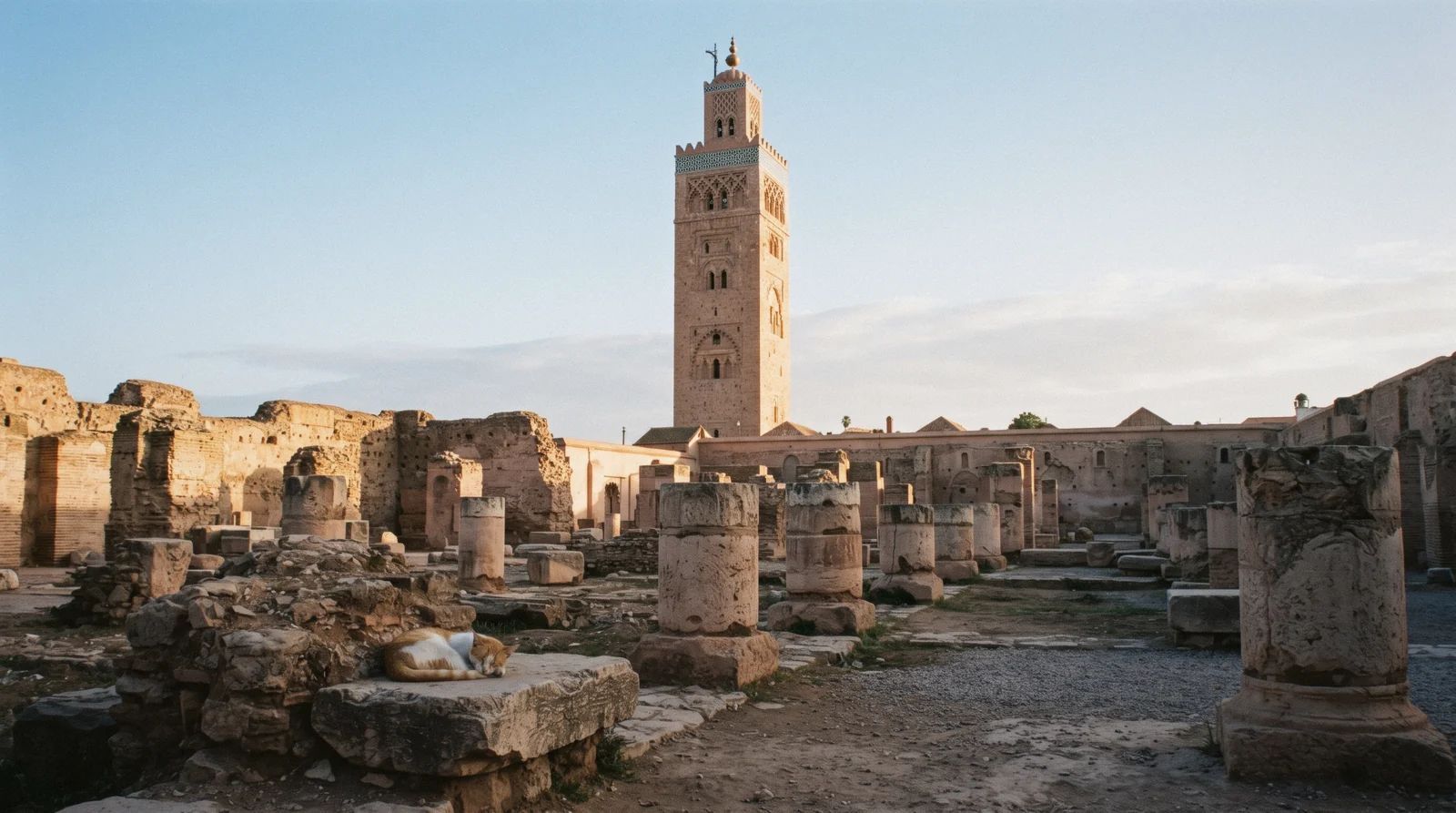
Koutoubia Mosque
The Koutoubia Mosque is the tallest building in the old city and the one landmark visible from almost every rooftop in it: a 77-metre Almohad minaret on the western edge of the medina, with a garden esplanade around it and the excavated footings of an earlier mosque alongside. It is also the monument most often misdescribed, because no Moroccan authority publishes a page about it, no ticket for it exists, and the interior is closed to non-Muslim visitors. This page sets out who actually states that rule, what you can see without entering, and where to stand. The square it faces is covered on the Jemaa el-Fna page, the ticketed monuments on the tickets index, and the city around the Koutoubia on the homepage.
Quick answer Who can go in, what it costs, how long to give it
You cannot go inside the Koutoubia Mosque unless you are Muslim, and the authority that states that rule is the French foreign ministry, not a Moroccan one: no first-party Moroccan source states it and the UK advice does not either. Everything outside is free and always open: the 77-metre minaret, the esplanade, the gardens and the excavated footings of the first mosque beside the standing one.
Key takeaways
- There is no ticket to buy and no queue to skip. The monument does not appear on the Ministry of Culture's selling platform at all, which lists five Marrakech sites and not this one, so anyone selling you Koutoubia entry is selling a walk past it
- If the point is to stand inside a historic Islamic building in Marrakech, the answer is the Medersa Ben Youssef at $5.33 (50 MAD): a former Quranic school rather than a working mosque, which is exactly why it is ticketed and open
- The three-hour walking tour of the monuments at $17.44 includes the Koutoubia from outside along with two ticketed palaces, which is the cheapest way to have the building explained rather than merely pointed at
- It is about six minutes on foot from Jemaa el-Fna, and the minaret is the compass point the whole medina navigates by
Key facts
Opening hours
| Esplanade and gardens | Open–No published hours |
|---|---|
| The mosque interior | Closed to non-Muslims–At all times |
Closed None for the outside. The interior is not open to non-Muslim visitors on any day.
Admission
- Adult
- Free
- Reduced
- Free
- Free
- Everyone, for the exterior, the esplanade and the gardens. No entry ticket to the mosque exists at any price
Planning it
- Time needed
- Not stated by any authority; our routing is 20 minutes for the esplanade and about 40 with the gardens and the excavated remains
- Address
- Avenue Mohammed V at Rue el Koutoubia, Medina, Marrakech
Those are two different visits and only one of them is possible here. The first row is the Koutoubia itself, which nobody ticket-sells; the second is the interior that is open to everyone and priced by its own ministry; the third is the guided walk that takes in the mosque from the esplanade. Figures read in Q3 2026 from each seller's own page.
Do you want to see the Koutoubia, or do you want to be inside an Islamic monument?
| What you get | Price | Who sets it | How it is bought | Book |
|---|---|---|---|---|
| The minaret, the esplanade, the gardens and the excavated first mosqueEveryone. This is the whole of what a non-Muslim visitor can see, and it costs nothing | Free | No authority. The monument is absent from the Ministry of Culture's ticketing platform | Nothing to buy; walk on from Avenue Mohammed V | Official site |
| The interior alternative: a former Quranic school 12 minutes northAnyone whose real question was what these buildings look like from the inside | $5.33 (50 MAD) foreign adult, $1.07 (10 MAD) under 12 | Ministere des Habous, on the monument's own site | Its own ticket office or its own website, daily 9:00 to 19:00 | Official site |
| Three-hour guided walk taking in the Koutoubia from outside, plus two ticketed monumentsVisitors who want the Almohad context explained on the spot and two palace entries in the same three hours | $17.44 | Operator price on GetYourGuide, read in Q3 2026 | Online, with free cancellation up to 24 hours before | Check Availability |
No row here sells Koutoubia entry, because no such product exists. The mosque is a working place of worship under the Ministry of Islamic Affairs, not a ticketed monument under the Ministry of Culture, and the two ministries run entirely separate estates. That split is the whole reason a foreign visitor pays nothing here and 100 MAD, about $10.65, three minutes away at a Ministry of Culture palace.
The guided walk that includes the Koutoubia
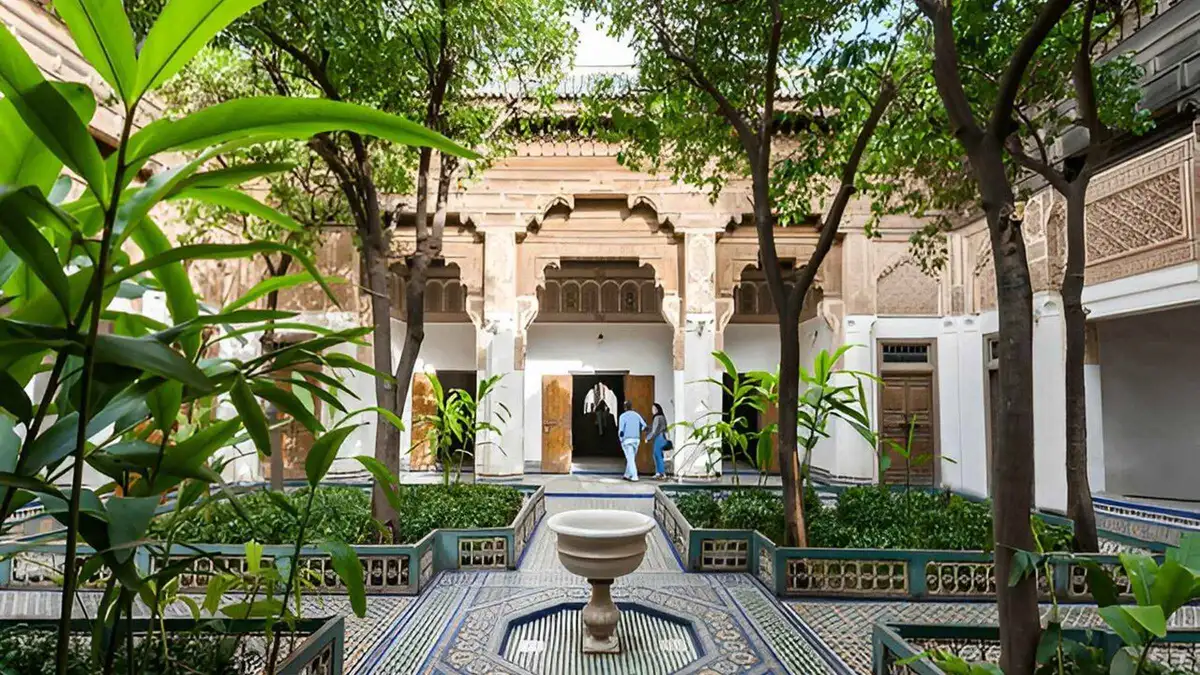
One card, because only one product on the market treats the Koutoubia as a stop rather than a background. The price is the operator's own listing in US dollars, read in Q3 2026, and the two monuments it enters are ticketed separately by the Ministry of Culture.
 from $17.44
Marrakech: Bahia Palace, Saadian Tombs, & Koutoubia Mosque
listed at $17.44
Three-hour guided walk taking in Bahia Palace, the Saadian Tombs and the Koutoubia from the outside. Monument entrance fees are paid separately in cash: 100 MAD each for Bahia Palace and the Saadian Tombs.
Check AvailabilityPrices, ratings and details are the platform's own, checked in Q3 2026; dollar figures are the listed prices — the platform bills in your account's currency.
Can you go inside the Koutoubia? The rule, and who actually states it
This is the question the page exists to answer, and the sourcing matters more than usual, because the rule is repeated everywhere and published almost nowhere.
The clearest authority statement we could find is French. France Diplomatie, in its practical advice for Morocco, puts it as: "Il est formellement interdit aux non-musulmans d'entrer dans les lieux de culte musulmans. Seuls les hauts lieux du tourisme peuvent etre visites." Non-Muslims are formally forbidden from entering Muslim places of worship, with only the major tourist sites open to visits.
That is the rule, and it applies to the Koutoubia as a working mosque.
What is striking is who does not say it. No page from the Ministry of Islamic Affairs, from the national tourist office or from the Commune de Marrakech stating the rule could be retrieved for this guide, and the UK FCDO does not state it either; its wording goes no further than respecting local traditions and religions, especially in religious areas. The nearest American document is a religious-freedom report noting that mosques close to the public shortly after daily prayer times, which is a closing-time rule and not an entry ban, and we will not paraphrase it into one.
So the honest position is that the rule is real, universally applied and cited here from a foreign ministry rather than a Moroccan one.
There is one national exception a visitor can act on, and it is not in this city. The Hassan II Mosque in Casablanca admits non-Muslims on guided visits, and its own foundation publishes both the slots, Saturday to Thursday at 09:00, 10:00, 11:00, 12:00, 15:00 and 16:00 and Friday at 09:00, 10:00, 15:00 and 16:00, and the tariffs: 140 dirhams for foreign adults, about $14.91, 70 for Moroccans, residents and foreign students, and 30 for children over four.
In Marrakech itself the substitute is the Medersa Ben Youssef, a few minutes north. It is a former Quranic school rather than a place of prayer, which is precisely why it is ticketed, open daily from 9:00 to 19:00 and priced at 50 MAD, about $5.33, for a foreign adult. If what you wanted was the courtyard, the zellige and the carved cedar of an Almohad-descended building, that is where it is, and the tickets index sets out how it is sold.
What you can see from the outside, and it is more than the minaret
The whole of a non-Muslim visit happens on public ground, so it is worth knowing what that ground actually holds.
The minaret is 77 metres, a figure published by the national tourist office, which calls it the lighthouse of Marrakech and names it as the model for the Hassan Tower in Rabat and the Giralda in Seville. Nothing else in the medina comes close to it, and the height is why it works as a navigation aid: from a rooftop terrace anywhere in the old city, the minaret tells you which way is west. The finial of copper spheres at the top is visible from the esplanade, and no official source we could reach publishes anything about it, so this page describes it and prints no measurement.
Beside the standing mosque are the excavated footings of an earlier one, laid out at ground level and free to walk around. No official Moroccan page names them as an attraction, which is a gap rather than a doubt: they are there, they are open, and they explain the alignment of the building next to them better than any label would. Around both runs a garden esplanade of rose beds, palms and benches, also free, also without published hours.
There is a dynastic conflict in the sources worth knowing before you repeat a date. The ICOMOS evaluation prepared for the 1985 World Heritage inscription treats the Koutoubia as part of the Almohad ensemble, naming it among the architectural masterpieces that alone would justify listing the medina. The national tourist office's own page instead attributes the mosque to the Almoravids.
The scholarly and heritage-body position is Almohad, the Almohads having taken Marrakesh in 1147, and where this site names a dynasty it names that one, with the disagreement printed rather than hidden.
The building has also been repaired in living memory. The most widely circulated recent footage of it, filmed after the earthquake that struck the region, shows damage in the medina and to historic fabric nearby; the state of the minaret itself is not something any official source we could reach publishes on. That is worth saying because you may arrive to scaffolding on part of the site, and no authority publishes a works schedule.
Hours, prayer times and the two hours the light is worth planning for
The Koutoubia has no visitor timetable of any kind, so what follows separates the two published facts from the practical reading.
What is published: nothing. The mosque follows prayer times, and the esplanade and gardens around it are open public ground with no stated opening or closing hour. No official page for the monument itself was reachable when this page was researched, which is unusual for a landmark of this rank and is the single most useful thing to know before you plan around a published figure you found somewhere else.
What follows in practice: the call to prayer is audible five times a day and the forecourt fills briefly around each of them, most visibly at Friday midday. Standing at a respectful distance while people arrive is normal and nobody is asked to leave, but photographing worshippers is not: consent is a legal requirement in Morocco under the data-protection law, as the Jemaa el-Fna page sets out in full. During Ramadan the rhythm shifts and the evening prayer draws the biggest crowd of the day.
For the photograph everyone wants, the useful times are the first hour after sunrise, when the east face is lit and the esplanade is nearly empty, and the twenty minutes after sunset, when the minaret is floodlit against a sky that still has colour in it. The middle of the day flattens the brickwork and, from June to August, makes the walk across open ground genuinely hot; the thirty-year record puts July highs at 36.6 degrees Celsius, and the best time to visit page has the month-by-month table.
How Much Time To Give The Koutoubia
No authority states a visit length, and for a building you cannot enter the honest answer is short. These three routings are ours, built from the walking distances and from what each version actually adds.
The decision is not how long to look at the minaret, it is whether the Koutoubia is a stop or a corner you turn on the way somewhere else. Both are legitimate; only one of them needs planning.
| Routing | What you get | What it skips | Door to door |
|---|---|---|---|
| The corner you turn | The minaret from the esplanade on the walk between Jemaa el-Fna and the avenue | The gardens, the excavated first mosque, any sense of the scale of the complex | About 10 minutes, and it costs nothing |
| The full circuit outside | A loop of the whole enclosure: east face, the rose gardens, the footings of the earlier mosque, the benches on the south side | Nothing available to a non-Muslim visitor. This is the complete visit | About 40 minutes at a walking pace, longer if you sit |
| With a guide, and two interiors | The three-hour monuments walk at $17.44 explains the building and adds two ticketed palaces you can go into | The gardens, which the group does not linger in | Three hours from the meeting point, entries included |
Our routing, if the day is tight: give it the ten minutes on the way past in daylight, then come back for the twenty minutes after sunset when it is lit. Both are free, and the second is the version most people remember.
Dress, photography and what not to do at the boundary
None of this is enforced with a barrier, which is exactly why it is worth knowing where the line sits.
On dress, the citable advice is again French: France Diplomatie recommends decent and discreet behaviour in all circumstances, respect for Muslim places of worship, and clothing that respects local usage. There is no dress code posted at the Koutoubia, no ticket desk to turn anyone away and no published rule about shoulders or knees on the esplanade. Covered shoulders and knees are the convention rather than a requirement, and what to wear in Marrakech sets out where that convention actually bites.
On photography, the building is fair game and people are not. Loi 09-08 treats a person's image as personal data and requires their unambiguous consent, and the UK FCDO's wording is to always ask permission before taking pictures of people, especially children. Both apply at the moment worshippers arrive, which is also the moment the picture looks best, so ask or wait.
Two practical boundaries. The doorways of the prayer hall are not a viewing gallery, and standing in one to photograph the interior is the one thing that reliably causes offence here. And drones need prior permission from the Directorate General for Civil Aviation, with Canadian advice going further and stating that drones may be confiscated on entry to the country, so the aerial shot of the minaret is not one to attempt.
Getting there, and which side to approach from
The Koutoubia sits where the medina meets the modern avenues, so it is reachable on foot from the old city and by road from the new one. Fares carry the caveats each source attaches to them.
On foot from Jemaa el-Fna it is about six minutes: leave the square at its south-western corner, cross Place Foucauld and follow the paved walk. Coming that way puts the minaret in front of you the whole time, which is the approach worth having on a first visit. From the Kasbah and the southern monuments it is about twelve minutes north along the ramparts.
By bus, the caveat is the same one that applies everywhere in the city: Supratours took the urban network over from ALSA in December 2025, and the last officially published urban fare, 4 MAD or about $0.43, dates from the previous operator. No post-handover fare table exists, so treat that figure as the last one published and read getting around Marrakech before you rely on it. Petits taxis are metered by law and the Marrakech tariff order is not published anywhere, so ask for the meter rather than a quoted price.
The caleche rank at Place Foucauld is two minutes away and the standard circuit passes the Koutoubia gardens. The trade is regulated under a permanent municipal order of 1935 and the horses are individually identified and inspected three times a year, but no fare is published by the commune, so agree the price and the length of the circuit before boarding. From the airport, bus 19 runs to Gueliz in 30 minutes for 30 MAD, about $3.20, and the taxi position is set out on the airport page.
Koutoubia Mosque on the map, and what is within a quarter of an hour
The mosque, the square it faces and the ticketed monuments around it. Coordinates come from Wikidata and from the Ministry of Culture's own ticketing platform; the walking times are our estimates from those distances and allow for the lanes not going straight.
Next stop from the Koutoubia
Three places within a quarter of an hour on foot, with our own walking estimates from the mapped distances.
Jemaa el-Fna
East across Place Foucauld and you are on the square, which is free at every hour and has no published closing time. The Jemaa el-Fna page sets out what the henna, the photographs and the food stalls actually cost, which is the one thing no authority publishes.
6 min walkSaadian Tombs
South through the Kasbah quarter, entered from beside the Kasbah mosque. A foreign adult pays 100 MAD, about $10.65, on the Ministry of Culture platform, against 30 MAD for a Moroccan national. The Saadian Tombs page has the two-tier tariff in full.
12 min walkLe Jardin Secret
North into the medina on Rue Mouassine. Published hours, a published tariff and the fullest accessibility statement of any venue in the city, including free and priority admission for wheelchair users and blind visitors with their carers.
10 min walkKoutoubia Mosque questions
Can tourists visit the Koutoubia Mosque?
Not inside, unless they are Muslim. France Diplomatie states that non-Muslims are formally forbidden from entering Muslim places of worship in Morocco, with only major tourist sites visitable, and no Moroccan first-party source publishes the rule at all. Everything outside is open to everyone and free: the minaret, the esplanade, the gardens and the excavated remains of the first mosque. If the interior is the point, the alternative in the table above is the Medersa Ben Youssef at $5.33 (50 MAD), a former Quranic school rather than a working mosque.
Is there an entrance fee for the Koutoubia Mosque?
There is no fee and no ticket, because there is nothing to sell. The monument does not appear on the Ministry of Culture's own ticketing platform, which lists the Almoravid Koubba, El Badi, the Bahia, the Menara pavilion and the Saadian Tombs for Marrakech and not this mosque. It sits under the Ministry of Islamic Affairs instead. Anyone offering to sell you entry is selling a guided walk past it, which is what the three-hour monuments tour honestly is.
What are the Koutoubia Mosque opening hours?
None are published, by anyone. The mosque follows prayer times as a working place of worship, and the esplanade and gardens around it are open public ground with no stated opening or closing hour. No official page for the monument itself was reachable when this guide was compiled, which is the honest answer to a question that many pages answer with an invented timetable.
How tall is the Koutoubia minaret?
77 metres, the figure published by Morocco's national tourist office, which calls it the lighthouse of Marrakech and names it as the model for the Hassan Tower in Rabat and the Giralda in Seville. It is the tallest structure in the old city and the reason a rooftop terrace anywhere in the medina can tell you which way is west.
Can women go into the Koutoubia Mosque?
The restriction that applies to visitors is about religion, not gender: the interior is closed to non-Muslims, women and men alike, and no official source publishes separate visiting arrangements for women. Muslim women pray there as elsewhere in Morocco. For non-Muslim visitors of any gender the visit is the exterior, and the advice on dress is France Diplomatie's, which asks for clothing respectful of local usage rather than any specific garment.
Who built the Koutoubia Mosque, and when?
The heritage record says the Almohads, the dynasty that took Marrakesh in 1147, and the ICOMOS evaluation for the 1985 World Heritage inscription names the Koutoubia among the masterpieces that alone would justify listing the old city. Morocco's own tourist office attributes it to the Almoravids instead. We print both because they conflict, and follow ICOMOS.
What is the best time of day to photograph the Koutoubia?
The first hour after sunrise, when the east face is lit and the esplanade is empty, and the twenty minutes after sunset, when the minaret is floodlit and the sky still has colour. The middle of the day flattens the brickwork, and from June to August the open ground is hot: the thirty-year record puts July highs at 36.6 degrees Celsius.
Where the Koutoubia fits in a day
Because it costs nothing and closes never, the Koutoubia is the one fixed point a Marrakech day can be built around rather than into. The monuments that need daylight and money come first: the Ministry of Culture sites publish 9:00 to 17:00, the Medersa Ben Youssef runs to 19:00. The mosque works at either end of that, on the walk in from the avenues in the morning or on the walk back to Jemaa el-Fna after the ticket offices have shut.
One planning note that is specific to this corner of the city. Friday changes the rhythm here more than anywhere else: the midday prayer draws the largest congregation of the week to the forecourt, and at the ticketed Ministry monuments Moroccan nationals enter free that day, which makes them busier. Neither fact stops a visit, and both are worth knowing before you fix an itinerary. The tickets index sets out the four separate ticket authorities, and the medina page puts the quarter in order.
The Koutoubia on Film: The Minaret, The Gardens, The Scale
Three short films that show what the walk around the enclosure actually looks like, which is the fastest way to see why a building you cannot enter is still worth twenty minutes.
Koutoubia Mosque | Marrakech landmark, Morocco |4k|
A 4K pass around the enclosure and the gardens, at the scale a photograph never conveys.
Video: Morocc_OH!This is the highest building in Marrakech city - Koutoubia Mosque
A short local film making the point this page makes with the 77-metre figure.
Video: Tarik BelasriKoutoubia Mosque, Marrakesh - Fascinating building and a true landmark
A walk-up from the avenue, useful for seeing which approach puts the minaret in front of you.
Video: Pieces-Of-PatrickVideos load from YouTube only when you press play.
Reviewed Q3 2026 (July–September 2026); next review Q4 2026. Prices, hours and terms are set by the venue or operator and confirmed at checkout.
We may earn a commission if you book through one of our links, at no extra cost to you. Full affiliate disclosure