 Marrakech Guidebook
The Marrakech Hammam: What Is Documented, and What Is Only House Rules
A Marrakech hammam takes 2 hours to have and a great deal longer to research honestly: it is the easiest thing in the city to book and the least documented. The national tourist office describes the ritual and names the products, and that is where the official record stops: no Moroccan authority publishes a price for a public hammam, no text draws a legal line between a neighbourhood bath and a spa, no licence regime for either could be found, and nothing about what to wear, when the men's and women's hours run or what to tip is set down by anybody with authority to set it down. This page separates the two layers cleanly. Everything sourced is attributed and quoted; everything else is labelled as the house rules of the individual bath, which is what it actually is. The two packages listed for Marrakech are compared with their real prices, the products you will be scrubbed with are the ones you can buy yourself in the souks, and how Marrakech fits together as a trip puts the hammam where it belongs in a trip.
Quick answer What happens, what it costs, and what is actually a rule
The two hammam packages listed for Marrakech run 2 and 3 hours and are priced at $44.78 and $53.08, both cancellable free up to 24 hours before. No Moroccan authority publishes a price for a neighbourhood public hammam, no legal distinction exists between a public bath and a spa hammam, and no official etiquette code exists at all. The ritual itself is described by the national tourist office: a steam bath, exfoliation with the kessa glove, and a wash.
Key takeaways
- The products are the sourced part: black soap, ghassoul clay, rose water, henna and the kessa glove are the tourist office's own list, and the same things are sold by weight in the apothecary stalls of the souks
- For a first hammam, book the slot rather than walking in: the two-hour traditional hammam at $44.78 carries a 4.6 rating from 3,875 reviews and includes the scrub and a massage, with no transfer
- If you want the ritual without finding the address yourself, the three-hour version with hotel transfer at $53.08 collects you and brings you back, which is the difference the extra $8.30 buys
- Everything you read about what to wear, single-sex hours and tipping the tayeba is house rules rather than law, and what to wear in Marrakech sets out the modesty question in the street as well as in the bath
What a Hammam Is, in the Tourist Office's Own Words
One official Moroccan source describes the hammam, and it is worth quoting rather than paraphrasing because almost everything else written on the subject is somebody's afternoon.
The tourist office puts it plainly: inherited from the Romans, the traditional hammam plays an important part in Moroccans' everyday life, and the traditional hammam or public bath also represents a convivial space. It then gives the ritual in three parts, which is the whole official definition: a steam bath similar to a sauna, skin exfoliation, and showering. That is a much smaller claim than the treatments sold to visitors, and holding on to it is useful.
A hammam is fundamentally a hot room, water and a scrub. Everything added to that, the massages, the oils, the rose petals, the tea afterwards, is a commercial layer on top of a public washing habit.
The products, which are the sourced part
The same source names what is used, and this list is worth carrying because it is the one thing you can verify by buying it: ghassoul, henna, black soap, rose water, herbs, green clay, and the glove scrub called kessa. Black soap is the olive-based paste smeared on before the scrub; ghassoul is the mineral clay from the Atlas used as a wash for hair and skin; the kessa is the coarse mitt that does the actual exfoliating. All of them are sold by weight in the apothecary stalls around Rahba Kedima, which is the cheapest way to take a hammam home with you and is covered on the souks page.
The line the tourist office draws, and the one it does not
Its wellness page sets the range as running from the traditional collective hammam to the spa centre in the luxury institutes of the major cities. That sentence is the closest thing to an official categorisation of hammams that exists, and it is a description rather than a rule. There is no published legal distinction between a neighbourhood hammam and a spa hammam in Morocco, and no licence regime for either was found in this research.
So when a spa calls itself traditional, no standard is being claimed and none is being broken.
The national tourist office's must-know page and its wellness page, both read in Q3 2026. Spelling and phrasing are as published.
What Actually Happens, Step by Step
The sequence below is the shape of a treatment as the operators describe their own products, aligned with the official three-part ritual. Timings are ours, because nobody publishes those either.
You undress in an antechamber, keep your underwear on in almost every visitor-facing hammam, and move into a hot, wet room where the steam does the first ten minutes of work by softening the skin. Then comes the black soap, left on for several minutes, then the kessa glove, applied by an attendant with a good deal more force than a European spa would use. The grey rolls coming off your arms are the point of the whole exercise, and the sight of them is the moment most first-timers understand what exfoliation means in this context.
Ghassoul clay or a hair wash often follows, then buckets of warm water, then a cool-down and mint tea.
Put a clock on that sequence and it looks like the table below. Every duration in it is ours, estimated from what the two listed packages sell as a 2 hour and a 3 hour treatment, because no hammam and no authority publishes a stage-by-stage timing. Treat it as the shape of the hour rather than as a schedule anybody will hold to.
| Stage | Roughly how long | What is happening | What to say if you want it different |
|---|---|---|---|
| Undressing and the antechamber | 5 minutes | Clothes off to underwear, slippers on, valuables stowed | Ask where things are kept before you hand anything over |
| The steam room | 10 to 15 minutes | Heat and humidity soften the skin so the scrub can work | Say if the heat is too much; stepping out for air is normal |
| Black soap | 5 to 10 minutes on the skin | Olive-based paste left to sit before it is rinsed | Mention sunburn, a new tattoo or broken skin now, not later |
| The kessa scrub | 15 to 20 minutes | The attendant works the glove over you firmly, limb by limb | Ask for it gentler at the start; it is a normal request |
| Ghassoul, hair and rinsing | 10 minutes | Clay wash and buckets of warm water | Say if you would rather skip the hair |
| Massage, on a booked package only | 30 to 45 minutes | Oil massage in a separate room after the wash | Name the pressure you want before it starts |
Where the booked treatments differ from that
A booked spa treatment adds a massage after the wash and puts the whole thing on a clock, which is what the durations on the cards are telling you: two hours on the shorter package and three on the longer one, of which the hammam itself is usually the first half. The operator of the two-hour treatment describes black soap, a kessa scrub and a massage in a city spa, and states that no transfer is included, so you make your own way to the address. The three-hour version includes hotel transfer both ways and sends the exact address after the booking is confirmed, which is worth knowing in advance because it means you cannot walk past and inspect it first.
How firm is firm
Firmer than you expect, and that is not a complaint about any particular house. The scrub is meant to remove the top layer of skin and it is done briskly by somebody who does it forty times a day. Nothing about it is dangerous, but it is worth saying out loud if you have sensitive skin, sunburn, a recent tattoo or a healing wound, because the attendant will otherwise work at the standard pace.
Neither the tourist office nor any Moroccan authority publishes health guidance on hammam use, so anything you read framed as a medical rule, including the confident lists of who should not go, has no official source behind it.
The Three Kinds of Hammam, and What Can Be Known About Each
The word covers three quite different rooms in Marrakech, and the useful comparison is not luxury but how much you can establish before you walk in. That column is the reason this table exists.
Nothing in the first column is a legal category, because no legal categories exist. These are the three kinds of place that trade under the same word, arranged by how much of what you need to know is published in advance.
| Kind | What it is | What is published in advance | What you agree on the spot |
|---|---|---|---|
| Neighbourhood public hammam | A working bath used by the street around it, single-sex by hours | Nothing. No price, no hours, no rules are published by any authority | The entry fee, the hire of a glove and soap, and the attendant's fee, all in cash |
| Riad or medina spa hammam | A private treatment room in a restored house, sold by appointment | The house's own menu, on its own terms, with no external standard behind it | Extras, tips, and anything not on the menu you were shown |
| Booked hammam package | The same treatment sold in advance through a platform | The price, the duration and the cancellation terms: $44.78 for 2 hours, $53.08 for 3 hours with transfer | Nothing, unless you add a treatment on the day |
Which one to choose, in a sentence
For a first hammam in Morocco, book a package: you know the price, the duration and the cancellation terms before you leave home, and none of those three is knowable at a neighbourhood bath. For a second or third, and if you speak enough French or Arabic to sort out the glove and the fee at the door, the public bath is the real thing and costs a fraction of it. What this guide will not do is print a dirham figure for that fraction, because no authority publishes one and every number circulating online is somebody's market observation.
Why no hammam is named on this page
The same reason no restaurant is named anywhere on this site: there is no citable list. Morocco has no MICHELIN restaurant selection, no equivalent guide covers its spas, and no Moroccan authority operates a register, a rating or a licence list for hammams that could be checked. Naming a bath here would mean copying somebody's blog ranking and dressing it as research.
Instead this page prices the two products that publish their own terms, describes what the three kinds of room are, and leaves the choosing to you and to the reviews on the operator's page.
What Nobody Publishes About Hammams
This is the weakest-sourced subject on this site and the page says so rather than covering it up. Every line below was chased to an authority and came back empty, which is itself the most useful thing you can know before you go.
Six things a visitor wants to know, and the honest state of the record on each. The right-hand column is what to do given the answer.
| The question | What is published | What to do instead |
|---|---|---|
| What does a public hammam cost? | Nothing. No authority publishes an entry price for a public or neighbourhood bath | Ask at the door, in cash, and expect glove, soap and attendant to be priced separately |
| Is a spa hammam legally different from a public one? | No published distinction exists, and no licence regime was found for either | Judge the room and the menu in front of you, not the word on the sign |
| What do I wear? | Not stated by any official source. It is each house's own rule | Underwear is the norm in visitor-facing hammams; ask when you book, and read what to wear for the street |
| When are the men's and women's hours? | Not stated anywhere. Single-sex hours are set house by house | Ask the house directly, or book a slot where the timing is confirmed for you |
| What do I tip the attendant? | Not stated. No tariff, guideline or convention is published by anybody | Carry small notes and decide in advance what the service is worth to you |
| Are hammams inspected? | Only obliquely: hygiene sits with the commune and occupational safety under the labour code | Treat cleanliness as something you look at, since no rating is published to check |
Why that matters more here than elsewhere
On most subjects on this site a missing figure is an inconvenience. Here it changes behaviour, because a hammam is one of the few things a visitor does undressed, alone and unable to leave quickly. Every practical rule you will read online about it, the towel question, the tipping figure, the gender hours, is somebody's report of one bath on one afternoon, and repeating it as a rule is how a visitor ends up arguing with an attendant about a convention that was never a convention.
Ask the house. It is a two-sentence conversation and it settles all six rows above.
Attempts made in Q3 2026 against the national tourist office, the commune, the tourism ministry and the consular advisories. Where an authority is silent, that silence is recorded rather than filled.
The One Institutional Source, and What It Does and Does Not Say
There is exactly one peer-reviewed study of Marrakech hammams in the record, and it is careful work about something other than tourism. It is used here for the institutional definition and for the fact that a hygiene by-law exists, and for nothing else.
The study opens with the sentence that makes the hammam legible to a visitor: in Morocco, traditional bains maures are used by almost the entire population. That is the frame the tourist industry sits inside. A hammam is not a treat here, it is where a great many households wash, which is why neighbourhood baths keep long hours, sit inside residential lanes, and cost a fraction of anything sold to a hotel guest.
The study describes the working environment inside them as particularly hot and humid, which is a statement about the staff's conditions rather than the clients' comfort.
The one regulation anybody could find
The same study cites a standing municipal by-law on hygiene conditions in bains maures, a permanent arrete of 22 September 1997. That is the only Marrakech-specific hammam regulation this research surfaced, and the text of it could not be retrieved, so its current status is unverified. Occupational hygiene and safety otherwise fall under Title IV, Book II of loi 65-99, the labour code.
Between them, those two are the whole regulatory picture: a municipal hygiene order nobody can read online and a general labour statute. There is no inspection rating, no posted certificate and no register to check.
What this page will not do with that study
It will not tell you what the baths are like now. The study is a quarter of a century old and it reports what it found then, including failures of the prevention rules and an absence of protective equipment for staff, along with laboratory findings from floor samples and from the well water feeding the baths. Reprinting those results as a description of a hammam in Marrakech today would be dishonest and alarmist in equal measure, and this guide will not do it.
What survives usefully from the study is the institutional picture: hammams are ordinary neighbourhood infrastructure, regulated for hygiene at commune level, staffed by people doing hot physical work.
Sante, Cahiers d'etudes et de recherches francophones, volume 10 number 1, a study of ten Marrakech bains maures and 60 workers, published record, read in Q3 2026. The study dates from 2000 and is not a description of any hammam today.
What To Bring, and What Is Provided
Two different lists, depending on which kind of room you booked. The house rules column is doing real work here: none of this is regulated, so the honest answer to most of it is that it depends on the establishment.
A booked package generally provides everything and a neighbourhood bath generally provides nothing, and the difference is what the price gap is buying more than any difference in the steam.
| Item | Booked package | Neighbourhood bath | Notes |
|---|---|---|---|
| Black soap and ghassoul | Included in the treatment | Bought or hired at the door, in cash | The same products are sold by weight in the souks |
| Kessa glove | Provided and used by the attendant | Bring your own or hire one | A used glove is not shared between clients in any visitor-facing house |
| Towel and slippers | Usually provided; confirm when you book | Bring your own | Not stated by any authority, so ask the house |
| Change of underwear | Bring it. You will be wet through | Bring it | Underwear is the norm in visitor-facing hammams; full nudity is not |
| Cash in small notes | Only if you add anything on the day | Essential, for entry, products and the attendant | The dirham is a closed currency you change on arrival: what Marrakech costs |
Leave behind
Jewellery, anything electronic you would mind losing, and any expectation that a locker is a safe. Storage arrangements vary from a supervised cubbyhole to a bench, and nothing about them is standardised or insured. Both the UK and French foreign ministries describe opportunistic theft in medina quarters generally, so the sensible reading is to carry the cash you need and leave the rest at the riad, exactly as safety and scams sets out for the street.
The two hammam treatments listed for Marrakech
Both are booked slots at city spas with the scrub, the black soap and a massage. The difference is an hour and a hotel transfer. Prices are the operator's own listing in US dollars for one adult, read in Q3 2026, and the calendar on each card shows what is still open for your date.
 from $44.78
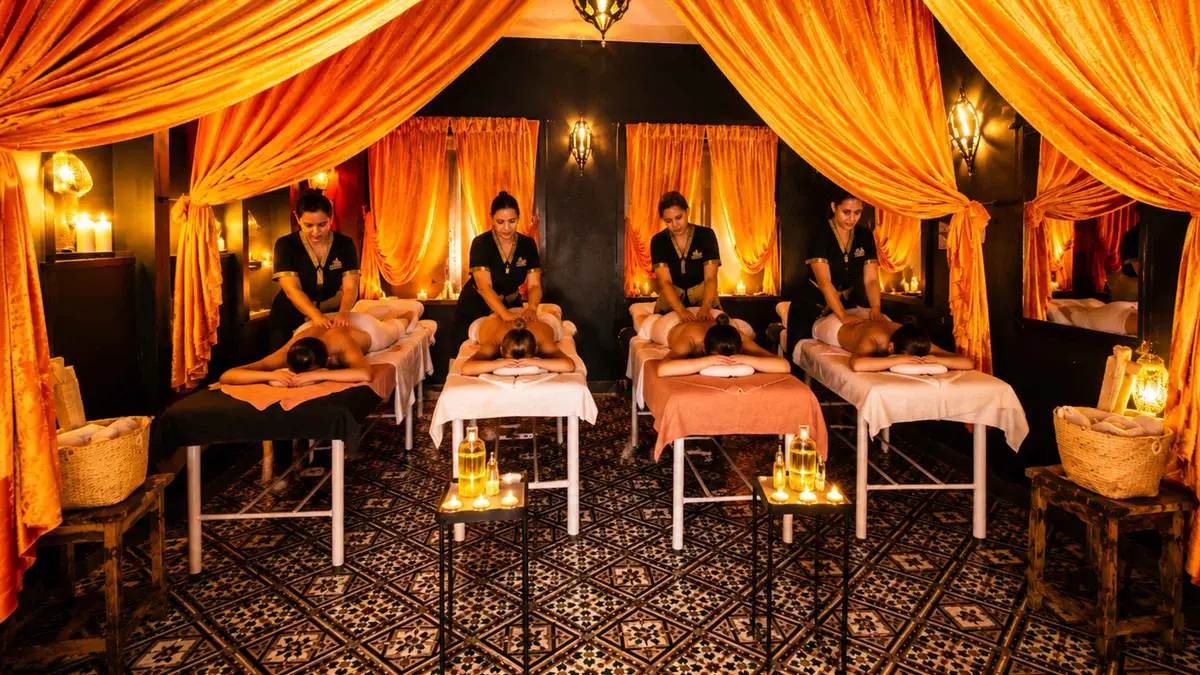
Marrakech: 2-Hour Traditional Moroccan Hammam Experience
listed at $44.78
Two-hour traditional hammam with black soap, kessa scrub and a massage at a city spa. No transfer included, so you make your own way there.
Check Availability from $53.08
Marrakech: 3-Hour Traditional Hammam Massage & Hotel Transfer
listed at $53.08
Three-hour hammam and massage package with hotel transfer both ways. The exact spa address and meeting details are sent after the booking is confirmed.
Check AvailabilityPrices, ratings and details are the platform's own, checked in Q3 2026; dollar figures are the listed prices — the platform bills in your account's currency.
The two packages side by side
Everything in this table is the operator's own published information, read in Q3 2026: price, duration, what is included and how each one gets you to the door. The last column is the one that decides it for most people, because the address of the shorter treatment is on the listing and the address of the longer one arrives after you have paid.
| What you book | Price | Length | Rating | Getting there |
|---|---|---|---|---|
| Traditional hammam with scrub and massage | $44.78 | 2 hours | 4.6 from 3,875 reviews | No transfer; the spa address is on the listing and you make your own way |
| Hammam, massage and hotel transfer | $53.08 | 3 hours | 4.3 from 2,174 reviews | Hotel transfer both ways; the meeting details are sent after the booking is confirmed |
Both cancel free up to 24 hours before the start time. The $8.30 between them buys an extra hour of treatment and the transfer, which is worth it if you are staying outside the medina and much less so if you are five minutes from the spa on foot. Ratings and review counts are the platform's own, shown as they stand.
When To Go, and Who Should Think Twice
The hammam is one of the few things in Marrakech that works better late in the day than early, and one of the few that interacts with the weather in the opposite direction to everything else.
Put it at the end of a walking day rather than the start of one, because the point of a scrub is what it does to legs that have covered eight kilometres of medina lanes, and because the monuments keep office hours the hammam does not compete for. In summer, when average highs run to 36.6°C in July and 36.2°C in August, a hot room is a harder sell in the afternoon than it is at eight in the evening; in winter, when January nights average 3.8°C, or 39°F, and few riads are heated, an evening hammam is the warmest hour of the day. A 19:00 or 20:00 slot works in every month of the year; a 14:00 one only works between November and March, when daily highs sit between 18.1°C and 22.7°C. The best time to visit has the full monthly record.
Ramadan
During Ramadan the whole rhythm of the day shifts to after sunset, and neighbourhood baths follow it: expect their busiest hours to move with the eating hours, and expect house timings to change without notice. Nothing about this is published by any authority, so a booked slot with a spa that confirms it in writing is the safer arrangement in that month. The dates are announced only shortly beforehand by the Ministry of Habous, since they follow crescent observation.
Who should think twice, honestly
Nobody official publishes a contraindication list for hammams, so this is judgement rather than guidance: a very hot, very humid room for an extended stretch is demanding, and the scrub is firm. If you are pregnant, recovering from illness, on medication that affects your tolerance of heat, or simply nervous about being handled by a stranger, the booked private treatment is a much easier first experience than a neighbourhood bath, and saying at the start that you would like the scrub gentler is normal and usually respected. Take that as one guide's reading and check anything medical with somebody qualified.
Couples and families
Public hammams are single-sex, by hours or by separate rooms, with no published timetable for either. Spa hammams sell couples' treatments where two people are treated in the same room, which is a commercial product rather than a traditional arrangement, and it is the only way a mixed pair goes in together. Children go with the parent of their own sex in a public bath; no operator or authority publishes an age rule, so ask when you book.
What to pair with a hammam
Three pages that answer what usually comes next: buying the products yourself, the dress question in the street, and the cash you need for anything unbooked.
The souks and the apothecary stalls
Black soap, ghassoul clay, rose water and kessa gloves are sold by weight around Rahba Kedima, which is the cheapest souvenir in the city and the one you will actually use. Nothing there is priced on a label, so the souks page sets out how a price gets agreed and what to check on the scale.
10 min walk north from the main squareWhat to wear in Marrakech
The dress question in a hammam is house rules, but the dress question in the street is a real one, and the French foreign ministry does publish wording on it. What to wear covers both, plus what actually works in a city where July averages 36.6°C and January nights drop to 3.8°C.
Read it before you packWhat Marrakech costs
Anything unbooked here is a cash transaction, and the dirham is a closed currency that cannot be bought before you fly, with a 2,000 MAD limit on what you may carry out. The costs page covers the machines, the banks and the two figures no Moroccan institution publishes.
The cash question, in one pageMarrakech hammam questions
How much does a hammam in Marrakech cost?
For a booked treatment, $44.78 for two hours or $53.08 for three hours with hotel transfer, both cancellable free up to 24 hours before. For a neighbourhood public bath, nobody publishes a figure: no Moroccan authority sets or records an entry price, so any number you find online is a market observation rather than a tariff. Take cash in small notes and ask at the door, where entry, soap, glove and the attendant are usually separate items.
What happens in a hammam in Marrakech?
The national tourist office gives the ritual in three parts: a steam bath similar to a sauna, skin exfoliation, and showering. In practice that means ten minutes in a hot wet room, black soap left to soften the skin, a firm scrub with the kessa glove applied by an attendant, often a ghassoul clay wash, then buckets of warm water and a cool-down. Booked spa treatments add a massage and put the whole thing on a two or three hour clock.
What do you wear in a Moroccan hammam?
Underwear, in almost every hammam a visitor will use. That is the norm rather than a rule: no Moroccan authority publishes a dress code for hammams, so what is expected is set by each house and the only reliable way to know is to ask when you book. Bring a dry change, because you will be soaked through. Full nudity is not the convention in visitor-facing baths, and swimwear is usually unnecessary.
Is a public hammam different from a spa hammam legally?
No published distinction exists. This research found no Moroccan text separating a neighbourhood bath from a spa hammam and no licence regime for either. The tourist office describes the range as running from the traditional collective hammam to the spa centres of the luxury institutes, which is a description and not a legal category. Hygiene sits with the commune, under a standing municipal order on bains maures dating from 1997, and occupational safety under the labour code.
Should I tip at a hammam, and how much?
Nobody publishes a figure or even a convention, so this page will not invent one. What is true is that in a neighbourhood bath the attendant who scrubs you is usually paid by you directly rather than by the house, which makes that payment part of the price rather than a gratuity. Decide before you go in what the service is worth to you, carry it in small notes, and hand it over at the end. In a booked package everything is included unless you add something on the day.
Is it safe and hygienic to use a hammam in Marrakech?
There is no rating or register to check, which is the honest answer. Hygiene in bains maures is governed at commune level under a standing municipal order, and the only peer-reviewed study of Marrakech hammams dates from 2000, covered ten baths and 60 workers, and is a study of working conditions rather than a guide to any bath today. Treat cleanliness as something you look at when you arrive, and choose a booked treatment for a first visit if that matters to you.
The Hammam on Film, Before You Undress in One
Three films that show the rooms, the scrub and the sequence, which is the fastest way to decide whether you want the public version, the spa version or neither.
Moroccan Hammam (Bath and Massage) Experience
A full run through a treatment from arrival to tea afterwards, filmed at the pace it actually happens.
Video: Where's Wataru7 Things to Be Aware Of When Taking a Moroccan Hammam Spa in Marrakech
The practical briefing, including the difference between the Turkish and Moroccan versions that trips people up.
Video: Travel & ExploreMarrakech Couples Hammam Experience
The couples' treatment sold by spas, which is the only arrangement in which a mixed pair goes in together.
Video: A Couple of NomadsVideos load from YouTube only when you press play.
Reviewed Q3 2026 (July–September 2026); next review Q4 2026. Prices, hours and terms are set by the venue or operator and confirmed at checkout.
We may earn a commission if you book through one of our links, at no extra cost to you. Full affiliate disclosure