 Marrakech Guidebook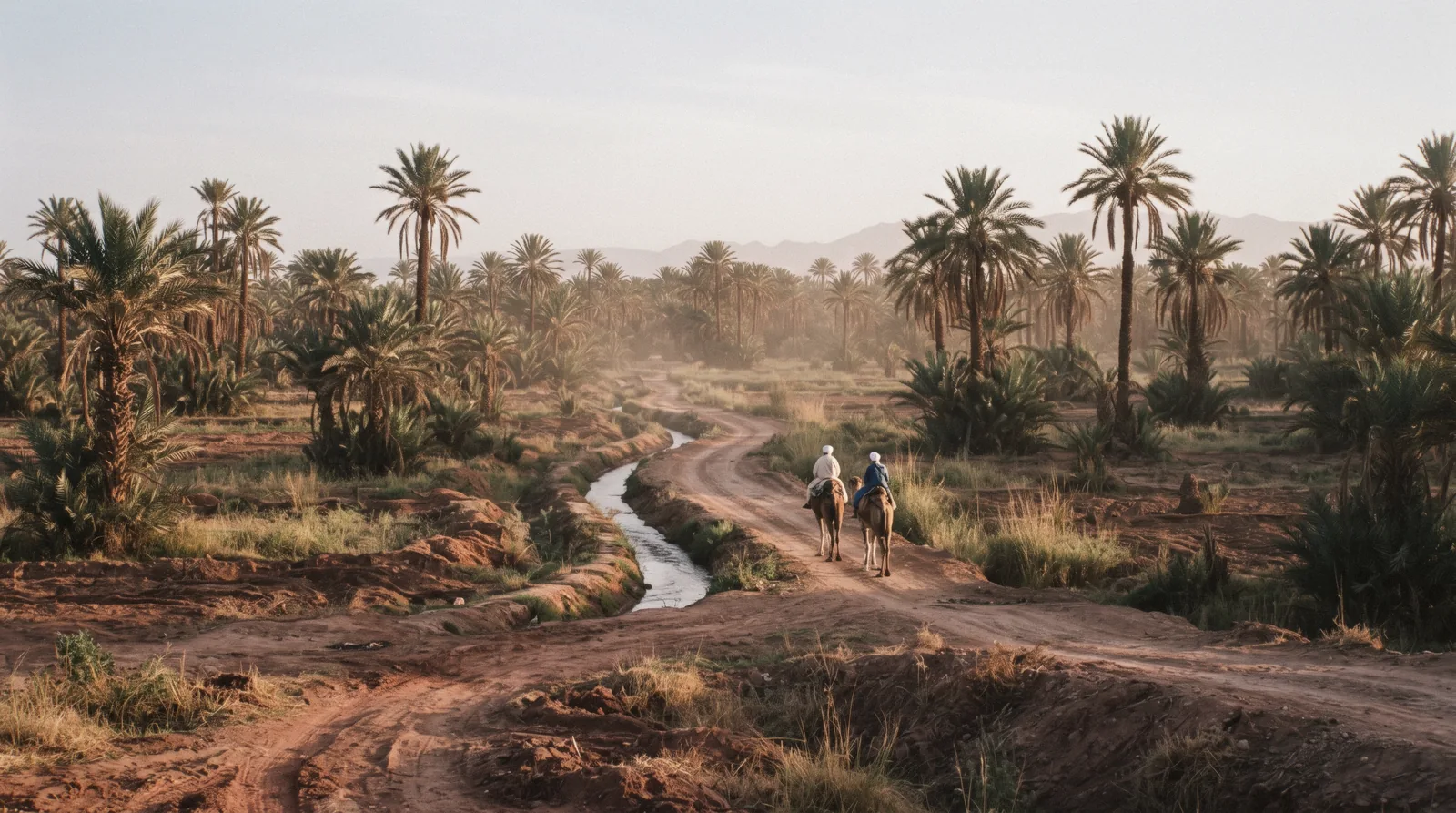
The Palmeraie of Marrakech: What Is Left of It, and What It Costs to See
The Palmeraie Marrakech visitors are driven out to see begins about 7 km north-east of the main square: a belt of date palms that is neither a garden nor an attraction, with no gate, no ticket, no opening hour and nothing to buy. It is an agricultural landscape of more than 12,000 hectares crossed by public roads, with hotels, private estates and camel camps inside it, and UNESCO's own file for the Medina of Marrakesh names it as one of the natural components of the property's setting while flagging it as vulnerable. The most interesting fact about the palm grove is not the camels: it is the khettaras, the underground drainage galleries whose abandonment UNESCO lists among the pressures on the site. This page sets out what is documented about the grove, what is honestly there to see today, what the rides listed for it cost, and how to get out there and back. The other green spaces in the city are compared on the gardens hub, and where this fits in a Marrakech trip is the front page of this guide.
Quick answer What it is, what it costs, and whether it earns the taxi
More than 12,000 hectares of date palms north-east of the city, free to enter because there is nothing to enter: no gate, no ticket, no hours. UNESCO names the palm grove among the natural components of the Medina of Marrakesh property's setting and states that its integrity is vulnerable to urban development, the abandonment of the khettara drainage galleries and the exploitation of the groves themselves.
Key takeaways
- Nothing here has an admission price, so the whole cost is transport and whatever you book: the sunset camel ride is listed at $16.27 for two hours with hotel transfer, and the daytime ride with a tea stop at $21.01
- It is about 7 km from Jemaa el-Fna in a straight line and there is no published bus fare to it, so a metered petit taxi or an included hotel pickup is how visitors actually get there; getting around Marrakech explains the meter rule
- If your reason for the trip is greenery rather than a ride, the ticketed gardens inside the city are the better hour: the gardens hub compares them, starting at $10.65 (100 MAD) for Le Jardin Secret
Key facts
Opening hours
| The grove and its roads, all year | Open–No published closing time |
|---|---|
| Camel camps along the roadside | not stated–not stated |
Closed None. It is open landscape crossed by public roads, with no gate and no closing day
Admission
- Adult
- Free. There is no admission and nothing to buy a ticket for
- Reduced
- Not applicable
- Free
- Everyone. No authority sells entry to the palm grove, and none publishes a tariff for anything inside it
Planning it
- Time needed
- Not stated by any authority; our routing is 2 hours for a booked ride, or 90 minutes for a drive through with two stops
- Book ahead
- Optional — walk-up usually fine
- Address
- North-east of Marrakech, between the Route de Fes and the Route de Casablanca
There is no admission to compare, so this table sets the free version against the rides listed for the grove. The first row is the royal foundation's own safeguarding programme page, the closest thing to an official publisher the Palmeraie has; the tour rows carry the operator's own listed price for one adult, read in Q3 2026.
Are you going for the landscape, which costs nothing, or for a booked ride inside it, which is the only thing anybody sells?
| What you are paying for | Price | What it includes | Cancel | Book |
|---|---|---|---|---|
| Driving or walking the public roads through the groveAnyone with a hire car or a patient taxi driver, and anyone whose interest is the palms rather than the saddle | Free, and no ticket exists | The landscape, the khettara ground and whatever the roadside camps are doing | Not applicable | Official site |
| Sunset camel ride, 2 hThe cheaper of the two and the better light; anyone who does not want to be on a camel in the middle of the afternoon | $16.27 | About an hour in the saddle at walking pace, hotel transfer both ways | Free up to 24 hours before | Check Availability |
| Daytime camel ride with tea, 2 hFamilies, since children aged 0 to 9 ride with an adult, and anyone who wants the tea stop rather than the sunset | $21.01 | Ride through the groves, a stop for tea, hotel pickup confirmed the evening before | Free up to 24 hours before | Check Availability |
The gap between the two rows is an hour of the day and a glass of tea, not a different grove: both ride the same roadside groves at walking pace. Arranging it at the roadside instead is possible and is what the operators' own alternative note describes, but there is no published rate to hold anyone to, so the booked price is the only figure on this page you can check in advance.
The rides listed for the Palmeraie
Every card here works the same belt of groves on the north-east edge of the city, both run two hours, and both include hotel transfer. Prices are the operator's own listing in US dollars for one adult, read in Q3 2026, and the calendar on each card shows what is still open for your date.
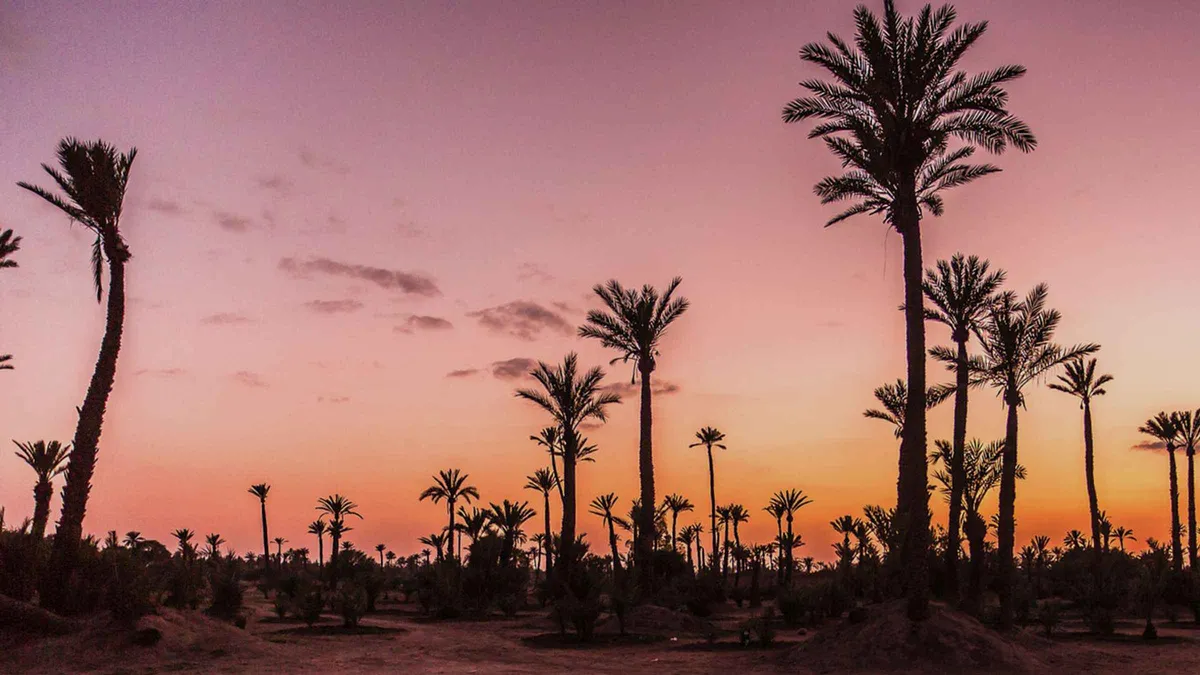 from $16.27
Marrakech Palmeraie: Camel Ride at Sunset
listed at $16.27
Two-hour sunset camel ride in the Palmeraie with hotel transfer both ways. Later start than the daytime rides, so the heat is off the sand.
Check Availability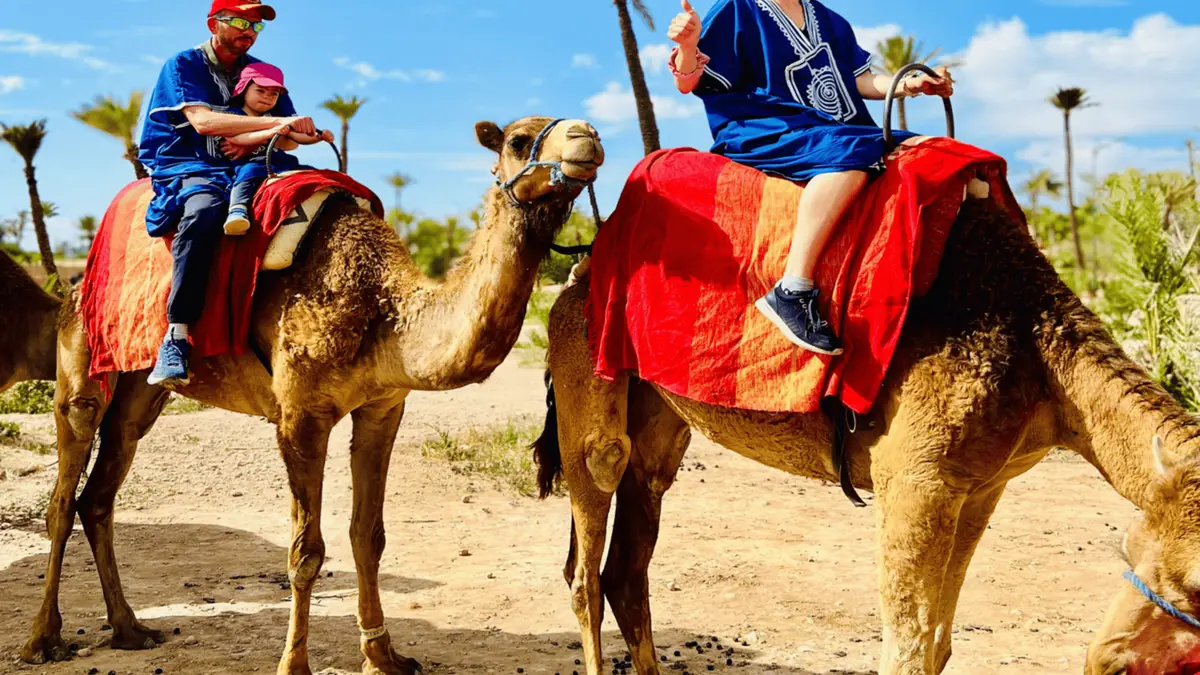 from $21.01
Marrakech: Camel Ride in the Oasis Palmeraie
listed at $21.01
Two-hour camel ride through the Palmeraie palm groves on the edge of town, with hotel pickup and a tea stop. The operator confirms the pickup time the evening before.
Check AvailabilityPrices, ratings and details are the platform's own, checked in Q3 2026; dollar figures are the listed prices — the platform bills in your account's currency.
What the Palmeraie Is, in the Words of the Bodies That Record It
Two official sources describe the palm grove and neither of them is a tourist page. Between them they explain both why it matters and why it looks the way it does now.
UNESCO's description of the medina property names its natural environment as, in its own words, notably the Gardens of Aguedal, Menara and the Palm Grove, the plantation of which is attributed to the Almoravids. That single clause carries two facts worth holding on to. The first is that the grove is treated as part of the setting of a World Heritage property rather than as a monument in it: the palms lie outside the inscribed boundary, in the surroundings the World Heritage Committee asked Morocco to protect when it inscribed the medina in 1985, alongside the Menara and the Bab Djedid gardens, by strictly enforcing a management plan adopted in 1981.
The second is the attribution: the planting is credited to the Almoravids, the dynasty that founded the city between 1070 and 1072, which makes the grove roughly as old as Marrakech itself.
The size, and who looks after it
The royal environmental foundation that runs the safeguarding programme puts the grove at more than 12,000 hectares and says in plain terms that it was threatened despite several legal texts protecting it, without naming any of them. The programme itself began in March 2007, after the King entrusted the palm grove's protection and development to Princess Lalla Hasnaa, and it has since involved a communal nursery, more than 600,000 young palms planted and works on the irrigation. Those are the only hard numbers anybody official publishes about the Palmeraie, and they are the reason this page can say something more useful than that the grove is pretty.
What no source would give us
No Moroccan protection decree for the Palmeraie could be obtained. The foundation refers to several legal texts and names none; a dahir of 1929 circulates in the press without a citation and is not repeated here as a fact. There is no published visitor figure, no map of what is still planted against what has been built on, and no authority that treats the grove as a visitable site with hours or rules.
So the honest position is that the Palmeraie has a guardian and a budget but no public rulebook, which is exactly what the drive through it looks like.
UNESCO's statement of Outstanding Universal Value and integrity statement for the Medina of Marrakesh, property 331, and the Fondation Mohammed VI pour la Protection de l'Environnement's own safeguarding programme page. Both read in Q3 2026.
The Khettaras: the Real Subject of This Page
The single most interesting thing about the Palmeraie is invisible from the road, and it is also the thing UNESCO names when it explains why the grove is at risk.
A khettara is an underground drainage gallery: a gently sloping tunnel dug from the water table towards the city, with vertical shafts at intervals for air and for spoil, which delivers groundwater by gravity without a pump and without evaporation loss. It is the technology that made a palm grove of this scale possible on a plain that gets only about 270 mm of rain a year across roughly 48 rain days, almost all of it between November and April. The palms did not grow here because the ground was wet.
They grew here because the water was moved.
What UNESCO actually says is going wrong
The integrity statement for the medina property is blunt about the setting. It records that integrity is vulnerable to pressure from urban development, the abandonment of the khettaras, which it glosses in its own text as underground drainage galleries, and the exploitation of the palm groves. Read that in order and it describes a chain rather than three separate complaints: land is built on, the galleries that watered it stop being maintained, and what remains of the grove is worked harder.
That is the story a visitor is actually looking at from the taxi window, and no guidebook tells it because it takes a heritage document rather than a press release.
Why this changes what you see out there
Once you know about the galleries, the Palmeraie stops reading as a neglected wood and starts reading as infrastructure that lost its maintenance. The thin, unevenly spaced palms, the bare ground between them, the walled estates cutting the belt into parcels: all of it follows from water that used to arrive by gravity and now does not. The 600,000 young palms the royal programme has planted are the visible half of the answer; the irrigation works are the half nobody photographs.
If you want one thing to look for on the drive, look for the lines of low mounds marking old shaft heads across open ground.
The integrity statement for World Heritage property 331, read in Q3 2026, which lists the pressures on the property's setting in its own words.
What Is Honestly There Today
This is the part of the Palmeraie that search results are least honest about, so here it is plainly: what the grove has become, and who each version of it suits.
The Palmeraie today is three things layered on the same ground, and which one you meet depends entirely on the road you take through it.
| What you meet | Where it is | What it costs | Who it suits |
|---|---|---|---|
| Working and recovering palm groves | Away from the main roads, in the older parcels | Free to look at from any public road | Anyone who came for the landscape and the khettara story |
| Roadside camel camps | Along the main routes through the belt, easy to spot | Booked from $16.27 on the sunset ride; nothing at the roadside is priced | Families and anyone who wants an hour in the saddle at walking pace |
| Resorts, villas and private estates | Behind walls across much of the belt | Room rates, and nothing published as a visitor tariff | People staying out here rather than visiting; see where to stay |
The honest verdict
The Palmeraie is not a beauty spot and it is not the Sahara. It is an agricultural belt in trouble, with hotels in it and camels beside the road, and the pictures that sell it are taken with a long lens pointed carefully away from the walls. That does not make it a bad hour: sunset among palms with the High Atlas going pink behind them is a genuinely good end to a day, and it costs less than a museum ticket.
It does mean that if you are choosing between this and a garden in the city, and you want green, the garden wins.
Quad bikes, buggies and what this guide will not tell you
Quad and buggy circuits are sold in the same belt and are among the most searched things attached to the Palmeraie's name. No authority publishes a rule, a permitted route, a noise limit or a tariff for any of them, and no operator we could check publishes a route map, so this guide prints nothing about where they are allowed to ride. What can be said is what UNESCO says about exploitation of the groves, and that riding a motor vehicle across the ground of a site described as vulnerable is a choice, not a neutral activity.
The camel rides above are the products this page is willing to put a price beside.
How Much Time To Give the Palmeraie
Nobody publishes a visit length for an open landscape, so these three routings are ours, built from the distance out of town and what each version actually offers.
The grove is about 7 km from the main square in a straight line and further by road, so transport is the real cost of the visit and the thing worth planning around. Both booked rides absorb it by including hotel transfer.
| Routing | What you get | What it skips | Door to door |
|---|---|---|---|
| The booked ride at sunset | Two hours at $16.27 including transfer, about an hour of it in the saddle | Any choice about the route, which is the operator's | About 2 hours from your riad door and back |
| The drive-through on your own | The roads, the old parcels, the shaft mounds and the walls, at your own pace | The saddle, and any explanation of what you are looking at | 90 minutes with a metered taxi waiting, which you agree first |
| The half-day out of town | The grove plus somewhere with a gate: Anima Garden at $14.91 (140 MAD) or the Menara basin | The medina, for the whole afternoon | 4 to 5 hours, and two separate road legs |
The decision, in one line
Take the sunset ride if there is a first-time visitor or a child in the group, and skip the Palmeraie entirely if your days are short and the medina monuments are still unseen. It is a good extra hour and a poor substitute for anything in the walled city.
Five Things Most Visitors Do Not Know About the Palmeraie
Five findings from the official record, each of which changes what you are looking at out there. Every one carries the source it came from.
- It is outside the World Heritage boundary, not inside it. The palm grove sits in the surroundings the World Heritage Committee asked Morocco to protect in 1985, alongside the Menara and the Bab Djedid gardens, by strictly enforcing a management plan adopted in 1981 [World Heritage Committee report SC-85/CONF.008/9, read in Q3 2026]. - UNESCO names the abandoned khettaras as a threat by name. The integrity statement for property 331 lists pressure from urban development, the abandonment of the khettaras, which it glosses as underground drainage galleries, and the exploitation of the palm groves [UNESCO statement of integrity, property 331]. - The planting is credited to the Almoravids. UNESCO's own description of the property's natural environment attributes the plantation of the palm grove to the dynasty that founded the city between 1070 and 1072 [UNESCO statement of Outstanding Universal Value]. - The rescue programme is royal, dated and specific. It began in March 2007 after the King entrusted the grove to Princess Lalla Hasnaa, and has since involved a communal nursery, more than 600,000 young palms and irrigation works across more than 12,000 hectares [Fondation Mohammed VI pour la Protection de l'Environnement]. - No protection decree could be obtained for it. The foundation says the grove was threatened despite several legal texts protecting it and names none of them; a 1929 dahir circulates in the press with no citation and is not treated as a fact here [fm6e.org, read in Q3 2026].
Getting to the Palmeraie and Back
The grove starts on the north-east edge of the city, between the Fes road and the Casablanca road, and no public transport fare to it is published anywhere.
The straight-line distance from Jemaa el-Fna is about 7 km, which is a 20 to 30 minute drive depending on which road into the belt you take and on the traffic on the ring. Both booked rides include hotel pickup and drop-off, and on the daytime ride the operator confirms the pickup time the evening before, which is the practical reason most visitors book rather than improvise.
By taxi, and the two figures that do not exist
A petit taxi is the default and the meter is the whole protection: it is compulsory under a dahir of 12 November 1963, restated by ministry circulars in 2022 and 2024, and no Marrakech tariff document is published by the commune, the wilaya or the ministry. That means there is no fare to quote you for this run and no figure to appeal to if the meter stays off. Agree that the meter will be used before the car moves, and agree separately what waiting costs if you want the driver to stay.
Ride-hailing is not lawful here: Uber withdrew in 2018, and inDrive and Bolt operate outside the legal framework.
By bus, and why nothing is printed here
The city bus network changed operator on 14 December 2025, when Supratours took over from ALSA after 26 years, and no post-handover fare table exists. The last officially published urban fare is 4 MAD. Since no line to the Palmeraie is documented after the handover, this guide prints no bus route for it at all rather than repeating a pre-handover number. Getting around Marrakech sets out what is knowable about each mode.
What to take
There is almost no shade in the groves and no shop on most of the roads. Take water, take a hat between May and September, when average highs run from 28.5°C to 36.6°C, and take small notes in cash for tea or a tip, because nothing out there takes a card. Evenings cool fast once the sun is off the palms, which is the argument for a layer even in warm months.
Palmeraie map: where the grove is against the city
The palm grove sits well outside the walls, which is the single thing a map settles faster than any paragraph. The grove's point is its verified Wikidata coordinate and every other pin is that place's own; road distances run longer than the straight lines shown here.
Coordinates from Wikidata and from each venue's own published point, read in Q3 2026. There is no official boundary published for the Palmeraie, so the green pin marks the grove's recorded centre rather than an edge.
Where to go instead, or afterwards
Nothing else is walkable from the Palmeraie, which is itself a planning fact. These three are the green alternatives inside or near the city, with honest travel times by road.
The gardens of Marrakech, compared
If greenery rather than a camel is the point of the outing, the ticketed gardens do it better and closer. The gardens hub puts the tariffs side by side, from a free basin at Menara to $18.11 (170 MAD) at the Jardin Majorelle, with the hours and the closing days that decide the morning.
20 to 30 min by taxi into the cityMenara Gardens
The other historic water landscape of Marrakech and the natural comparison with the palm grove: an olive plantation around a twelfth-century basin, named beside the Palmeraie in the same UNESCO recommendation of 1985. The grounds are free and the pavilion is on the Ministry of Culture tariff at 60 MAD. The Menara page has the detail.
About 30 min by taxi, on the other side of the cityAnima Garden
The other out-of-town green trip, and the opposite proposition: a designed artist's garden with a published tariff of $14.91 (140 MAD), a shuttle from the city and stated hours. Take it when you want a planned landscape rather than an agricultural one. The Anima Garden page covers the shuttle and the ticket.
About 45 min by road, south on the Ourika roadPalmeraie Marrakech questions
Is there an entrance fee for the Palmeraie?
No. There is no gate, no ticket and no admission of any kind, because the palm grove is open agricultural land crossed by public roads rather than a park. The only money involved is transport and whatever you choose to book inside it. The rides listed for the grove start at $16.27 for the sunset ride, and everything else you see out there is either private property or free to look at from the road.
How far is the Palmeraie from Marrakech city centre?
About 7 km from Jemaa el-Fna in a straight line, on the north-east side of the city between the Fes road and the Casablanca road, which is a 20 to 30 minute drive depending on the route and the traffic. No post-handover bus fare is published for any line serving it, so a metered petit taxi or the hotel pickup included in a booked ride is how visitors actually get there.
What is there to do in the Palmeraie?
Three things, honestly. Look at the landscape from the public roads, which costs nothing; take a booked camel ride at walking pace, which runs two hours with hotel transfer from $16.27; or stay in one of the hotels inside the belt, which is a different sort of trip covered on where to stay. There is no visitor centre, no marked trail and no viewpoint, because nobody administers the grove as a site.
Is the Palmeraie worth visiting?
As a late-afternoon extra, yes; as a substitute for a day in the medina, no. It is an agricultural belt under pressure rather than a beauty spot, with resorts and walls through much of it, and UNESCO's own integrity statement describes exactly why it looks thinner than the photographs suggest. Sunset among the palms with the Atlas behind them is a good hour and cheaper than most museum tickets, which is a fair way to judge it.
What happens on a Palmeraie camel ride?
You are collected from your hotel, driven out to a roadside camp in the groves, helped into a saddle and led at walking pace for about an hour, usually in a train of several animals, then driven back. Mounting and dismounting is the awkward part rather than the ride. The daytime ride at $21.01 adds a tea stop and lets children aged 0 to 9 ride with an adult; the sunset ride at $16.27 trades the tea for the light.
Why does the Palmeraie look neglected?
Because the water system that made it stopped being maintained. UNESCO's integrity statement for the medina property lists pressure from urban development, the abandonment of the khettaras, its own term for the underground drainage galleries, and the exploitation of the palm groves. The royal safeguarding programme launched in March 2007 has planted more than 600,000 young palms and worked on the irrigation, which is why the parcels furthest from the roads look better than the ones beside them.
Where the Palmeraie fits in a day in Marrakech
It belongs at the end of a day, not in the middle of one. The monuments in the walled city keep office hours, mostly 9:00 to 17:00 on the Ministry of Culture sites and 9:00 to 19:00 at the madrasa, so an afternoon spent driving out to the groves costs you doors that will be shut by the time you are back. A ride that starts late enough to finish at sunset takes the hours nothing else is using.
The sequence that works on a three-day trip: monuments and souks on the first two days, then the Palmeraie or an out-of-town garden on the third, with Jemaa el-Fna at the end of every evening. If a day out of the city is what you actually want, the mountains do it better than the palm grove: the Ourika valley is an hour south and green in a way the Palmeraie has not been for a generation.
The Palmeraie on Film: What the Photographs Leave Out
Three films that between them show the honest version: the roads through the groves, the tourism board's own pitch, and the resort layer that now occupies much of the belt.
La Palmeraie Marrakech 4K: Morning Drive
An unedited morning drive through the belt, which is the single most useful thing to watch before deciding whether to go.
Video: Street MAJe suis a La Palmeraie, tu viens ?
The regional tourism board's own short film about the grove, useful as the official pitch to weigh against the drive above.
Video: Visit Marrakech RegionMarrakech, Morocco: Stay at an All Inclusive Hotel in the Palmeraie
The resort layer in full, which is what much of the palm belt has actually become and what a visitor sees behind the walls.
Video: My Grey Gap YearVideos load from YouTube only when you press play.
Reviewed Q3 2026 (July–September 2026); next review Q4 2026. Prices, hours and terms are set by the venue or operator and confirmed at checkout.
We may earn a commission if you book through one of our links, at no extra cost to you. Full affiliate disclosure